

When people search "can dogs soak in hot springs," they're usually asking one of the following:
- We're staying at a pet-friendly onsen resort — can the dog join us in the pool?
- We have hot spring powder or a bath additive at home — what if the dog accidentally got into it?
- We've heard sulfur has something to do with skin care — can we use it to wash the dog?
These three questions don't share a single answer. Let's take them one at a time.
Part One: Pet-Friendly Accommodation Is Not the Same as Dogs Can Soak in Hot Springs
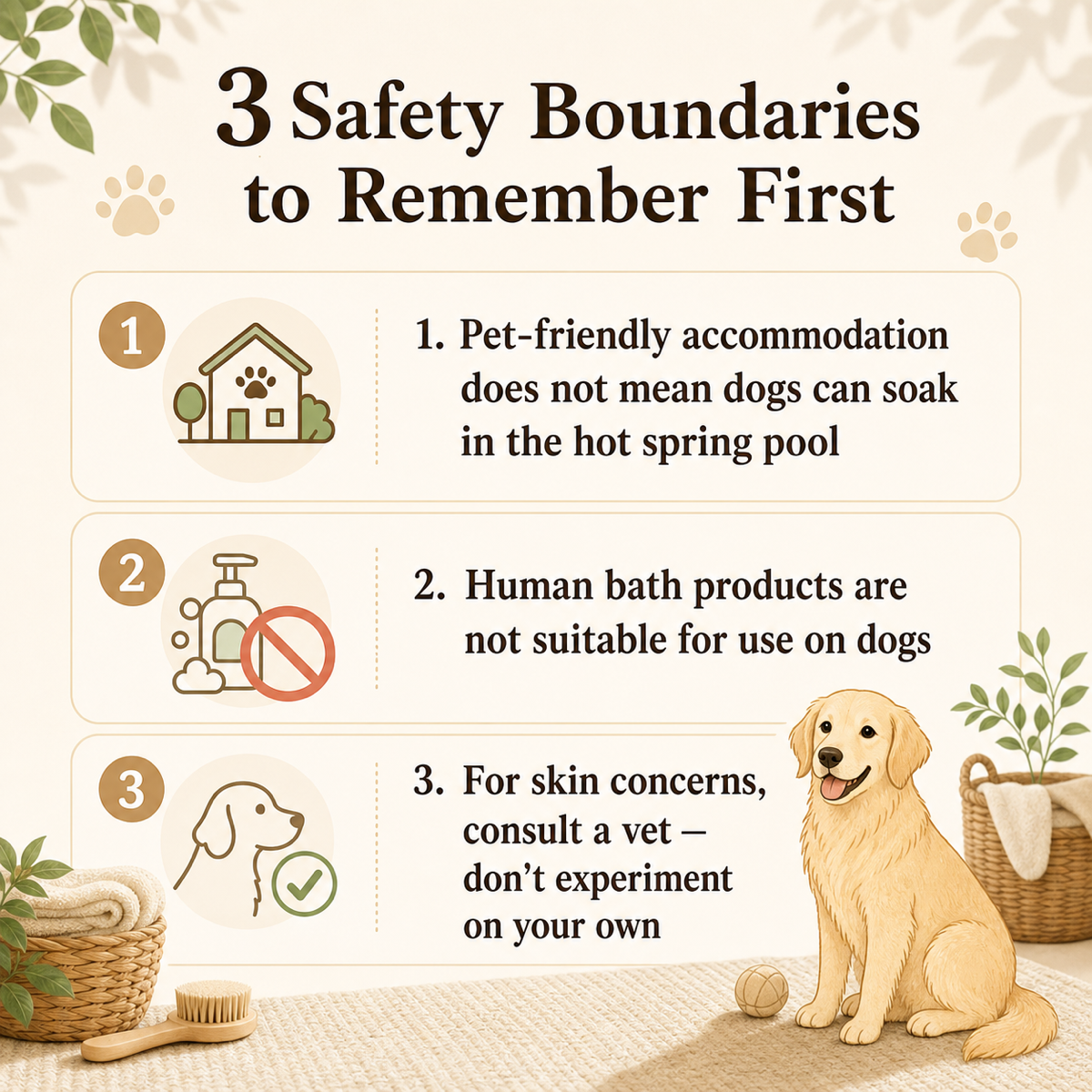
Taiwan has seen a growing number of pet-friendly hotels and hot spring inns in recent years. But "pet-friendly" typically means pets are welcome in the room, in designated common areas, or in outdoor spaces — it does not mean pets are permitted in the hot spring pools.
Most onsen venues restrict pets from entering shared baths. Whether a private hot spring room allows pets requires checking with each property individually. The reasons usually involve water temperature, safety, hygiene, consideration for other guests, and venue management.
Dogs regulate body heat very differently from humans — primarily through panting and through the pads of their feet. It's not safe to assume that because humans enjoy long soaks in hot water, dogs are equally suited to it. Hot spring mineral composition and pH are also not interchangeable with what dog skin can handle.
Taking your dog to a pet-friendly hot spring resort can be a wonderful trip. But whether a dog should actually come into contact with hot spring water is a question for the property's rules and your veterinarian — not an assumption based on human experience.
Part Two: How Dog Skin Differs from Human Skin
To understand why human bath products are not suitable for dogs, it helps to start with the skin itself.
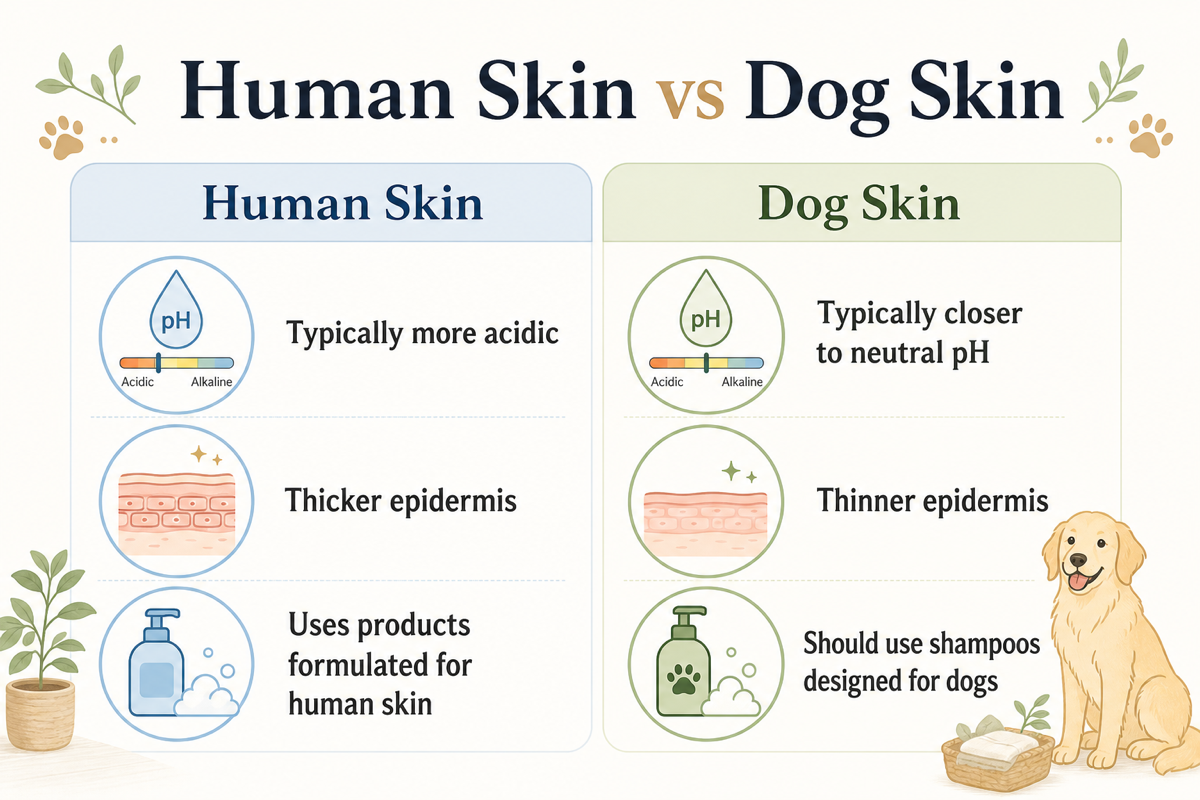
| Factor | Humans | Dogs |
|---|---|---|
| Skin pH | Typically more acidic | Typically closer to neutral |
| Epidermis thickness | Thicker | Thinner |
| Bathing products | Formulated for human skin and hair | Should use products designed specifically for dogs |
Human body wash, shampoo, bath powder, and bath additives are formulated around human skin biology and habits. Using them on a dog may not match the dog's skin pH or support its skin barrier properly.
General pet care guidance consistently recommends using shampoos specifically formulated for dogs, and adjusting bathing frequency based on breed, activity level, coat, skin condition, and veterinary advice. If a dog already has a skin condition, using human products is an even more avoidable risk.
Part Three: Sulfur in Veterinary Use Is an Entirely Different Category
You'll sometimes see "sulfur" and "pet skin care" mentioned together online. This deserves careful handling.
In the veterinary external-use world, there is a category of products called lime sulfur dip. These preparations may be used for certain skin conditions, but they are veterinary external-use products — applied under veterinary judgment and used according to product labeling and professional instruction regarding dilution, application, and monitoring.
That is an entirely different product category from consumer hot spring powder or bath additives for home use.
| Category | Veterinary Lime Sulfur Dip | Consumer Hot Spring Powder / Bath Additive |
|---|---|---|
| Use context | Applied under veterinary diagnosis and instruction | Human home bathing |
| Purpose | Specific external care or treatment context | Daily bathing experience |
| Who uses it | Determined by veterinarian | General adult home use |
| Are they interchangeable? | No | No |
If a dog shows skin issues, hair loss, itching, redness, or unusual odor, the right starting point is a veterinary evaluation of the cause — not a product search based on the word "sulfur."
Part Four: What If a Dog Accidentally Comes Into Contact with Human Bath Products?
For minor, brief contact — for example, a dog stepping into diluted bathwater — there are a few reasonable steps:
- Rinse the contact area with clean water
- Watch for skin redness, excessive licking, vomiting, or other signs of discomfort
- If any of these appear, contact a veterinarian
Prolonged or significant contact with human bath additives or hot spring powder is not recommended. These products are not designed for dog skin and should not be used intentionally for dog bathing or soaking.
If someone asks "can I use DaFang hot spring powder on my dog?" — the answer is clear: DaFang white-sulfur hot spring powder is a human home-bathing product. It is not a pet grooming product and it is not a veterinary external-use product.
Part Five: How to Approach Skin or Coat Concerns in Dogs
Dog skin problems can have many different causes — environmental or food allergies, fleas or mites, bacterial or fungal infections, seasonal changes, endocrine issues, breed characteristics, and more.
A more reliable process looks like this:
- Observe where the issue appears, how large the affected area is, whether there's itching, and whether there's crusting or unusual odor.
- Note any recent changes — diet, environment, outdoor activity, or bathing products.
- Visit a veterinarian to identify the cause.
- Follow veterinary recommendations for cleaning, care, or external products.
Without knowing the cause, trying different products repeatedly can make the picture harder to read — and can delay addressing what actually needs attention.
Part Six: Where DaFang Fits in This Picture
DaFang 1956 has been producing Beitou white-sulfur hot spring powder since 1956 — a human home-bathing brand. Our products are designed for adult daily soaking, footbaths, and half-body baths, so people at home can experience the Beitou white-sulfur mineral atmosphere.
DaFang is not a pet bath product. It is not a pet shampoo. It is not a veterinary skin external-use product.
| DaFang White-Sulfur Hot Spring Powder | Fits | Does Not Fit |
|---|---|---|
| Human home bathing | Adult daily soaking, footbath, half-body bath | Use on pets |
| Beitou white-sulfur mineral bath experience | People researching human hot spring powder | Veterinary or pet skin care use |
If you originally came here looking for information on human home bathing products, a good starting point is the correct usage guide:
How to Use DaFang Hot Spring Powder: White-Sulfur Powder Instructions & Cold Soak Tips
FAQ
Q1: We're staying at a pet-friendly onsen hotel — can the dog join us in the hot spring?
In most cases, no. Pet-friendly accommodation means pets are welcome in rooms or designated areas — it does not mean they can enter hot spring pools. Confirm with the property before assuming.
Q2: My dog accidentally got into my bath additive or hot spring powder — is that dangerous?
For minor, brief contact, rinse the area with clean water and observe. If the dog shows redness, excessive licking, vomiting, or other unusual signs, contact a veterinarian. Prolonged or large-scale contact with human bath products is not recommended.
Q3: I've heard sulfur can help with dog skin — can I try a sulfur product on my dog at home?
Not recommended. The lime sulfur dip used in veterinary practice is a specific external-use preparation applied under veterinary judgment and product instructions. It is a different product category from human hot spring powder.
Q4: Can human bath products — including hot spring powder — be used to wash a dog?
Not recommended. Dog skin differs from human skin. Use a shampoo specifically formulated for dogs. If the dog has a skin condition, consult a veterinarian first.
Q5: Can DaFang hot spring powder be used on dogs?
No — not for pet bathing or pet skin care. DaFang white-sulfur hot spring powder is a human home-bathing product. It is not a pet product and it is not a veterinary external-use product.
Q6: How often should a dog be bathed?
There's no single answer — it depends on breed, coat type, activity level, season, and skin condition. The general principle is to avoid over-washing, and to use a shampoo designed for dogs. Follow veterinary guidance if there are skin concerns.
Q7: My dog has a skin issue — is it okay to try different products on my own?
Not recommended. Skin problems have many possible causes, and different causes require different responses. Getting a veterinary evaluation before trying products is safer than experimenting and potentially making the picture harder to diagnose.
Conclusion: Find Out Which Question You're Actually Asking
"Can dogs soak in hot springs?" is actually three different questions: pet-friendly accommodation, accidental contact with human bath products, and knowledge about sulfur compounds. They need to be addressed separately.
For dogs, the right starting point for skin or bathing questions is pet-specific products and veterinary advice. For people researching human home bathing products, DaFang offers white-sulfur hot spring powder with a clear usage guide and pack selection information.