
Other language versions: 繁體中文 · 日本語
The short version
- Beitou's heat comes from the Tatun Volcano Group; a 2019 Academia Sinica study found a magma chamber still lies beneath it, with the most recent eruption about five to six thousand years ago.note 1
- Beitou has three spring types: white sulfur (Sulfur Valley, about pH 3 to 5), green sulfur (Thermal Valley, about pH 1 to 2) and iron sulfur (around Shamao Mountain and Shuangchongxi in Yangmingshan, about pH 6 to 7).note 2note 3
- Tanghua is the pale-yellow crystal that white sulfur water leaves behind as it cools; it does not dissolve, so bath water stays almost clear with a faint pale-yellow tint.
- Hokutolite is a slightly radioactive, lead-bearing barite known only from the Beitou River and Tamagawa Onsen in Akita, Japan.note 8
Beitou is familiar to everyone in Taiwan, yet how white sulfur water makes its way from deep underground into a bath is something few people could explain. This article begins with the geology of the Tatun Volcano Group, walks through Sulfur Valley and Thermal Valley as two separate sources, and then looks back at Beitou itself: sulfur mining under the Qing, the opening of the baths under Japanese rule, the boom and the decline after the war, and the old bathhouses still trading today. At the end there is a side note on a mineral found only in the Beitou River and at Tamagawa Onsen in Akita, Japan.
The Tatun Volcano Group: how Beitou's hot springs are made
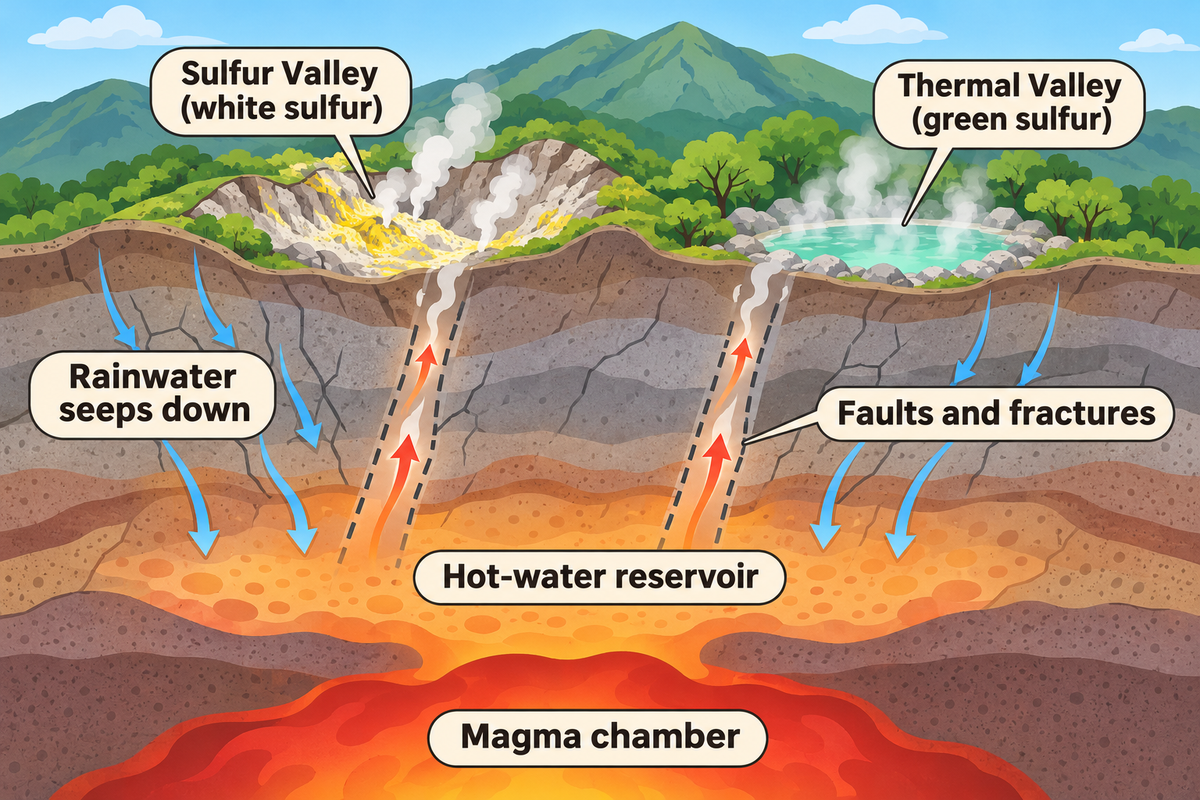
The heat under Beitou comes from the Tatun Volcano Group, along the northern rim of the Taipei Basin. The group is made up of more than twenty volcanic bodies, Mount Qixing, Mount Datun and Mount Shamao among them.
Many people assume Mount Datun is extinct. Research published in 2019 by Lin Cheng-Horng's team at the Institute of Earth Sciences, Academia Sinica, used both S-wave and P-wave characteristics in seismic data together, and confirmed that a magma chamber still sits beneath the Tatun Volcano Group, which makes it an active volcano; the most recent eruption was around five to six thousand years ago.note 1 The team described the chamber as roughly the size of a quarter of one of Taipei's administrative districts.note 1
That chamber keeps pushing heat and volcanic gas upward, the gas being mainly hydrogen sulfide, carbon dioxide and water vapour. Rainwater seeps down from the surface along cracks in the rock, is heated by the deep heat source, mixes with the volcanic gas, and rises again along faults and fractures until it surfaces around Beitou as the hot spring water everyone knows.
White sulfur, green sulfur, iron sulfur: telling Beitou's three spring types apart
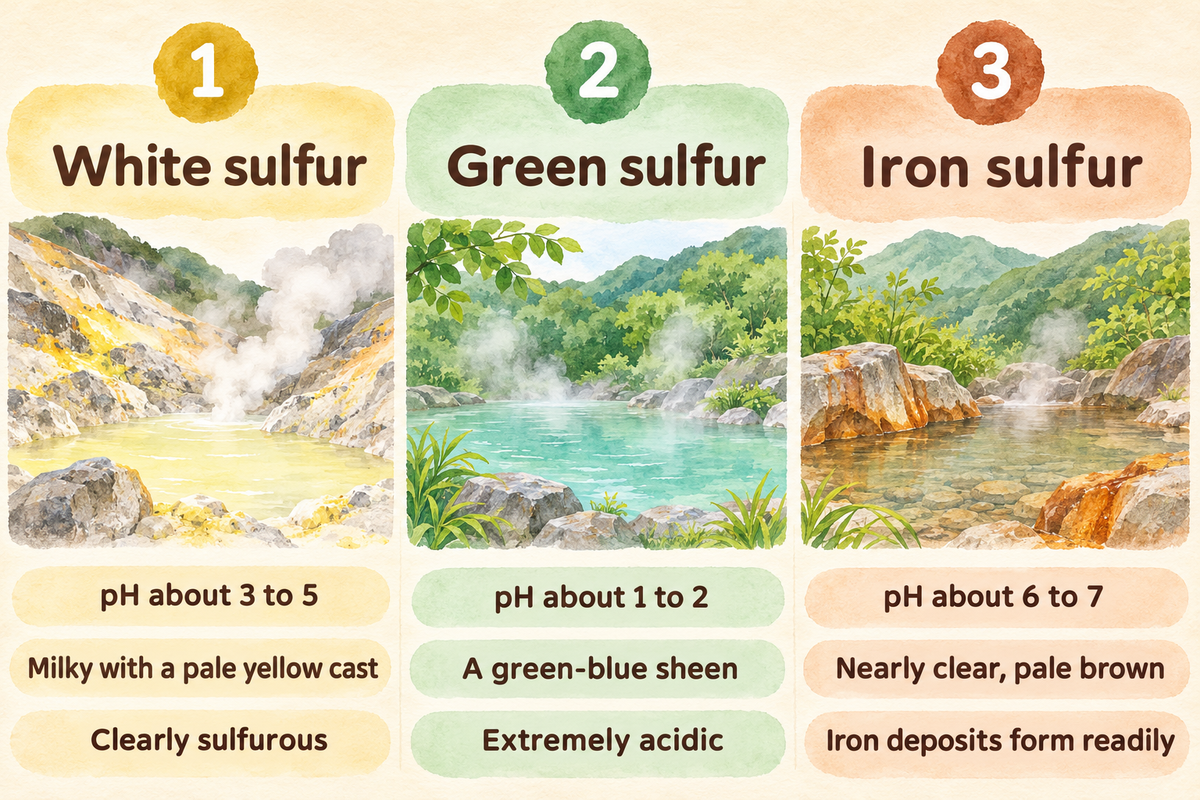
Beitou's springs are traditionally sorted into three types. What separates them is the route the hot water takes underground, and which gases and rocks it meets on the way.
| Spring type | Common name | Representative source | pH | Appearance and smell |
|---|---|---|---|---|
| Acidic sulfate spring | White sulfur | Sulfur Valley | about pH 3 to 5note 2 | Milky with a pale yellow cast, clearly sulfurous |
| Strongly acidic sulfate chloride spring | Green sulfur | Thermal Valley | about pH 1 to 2note 3 | A green-blue sheen, extremely acidic |
| Carbonate spring | Iron sulfur | Mount Shamao and the Shuangchongxi area, Yangmingshan | about pH 6 to 7note 3 | Nearly clear with a pale brown tint, iron deposits form readily |
White sulfur is the most common spring type in Beitou and the one most people soak in. Hydrogen sulfide rising from below meets oxygen-bearing groundwater at a shallower depth, oxidises into sulfuric acid, and reacts with minerals in the rock, which produces the sulfate-rich white sulfur water. As that water cools and meets the air, the sulfur and minerals in it separate out slowly into fine pale yellow crystals that do not dissolve in water. These are tanghua, the sulfur bloom. Tanghua dropped into hot water does not turn the bath milk-white; the water stays close to clear with a faint yellow cast, some of the bloom drifting in the water and some settling on the bottom of the tub.
Green sulfur is far more acidic, a strong acid spring unique to Beitou and rarely found elsewhere in Taiwan. Iron sulfur sits close to neutral and is mainly seen around Yangmingshan.
Sulfur Valley and Thermal Valley: two different sources
These two places get mixed up constantly, when in fact each is the source of one of Beitou's two main spring types.
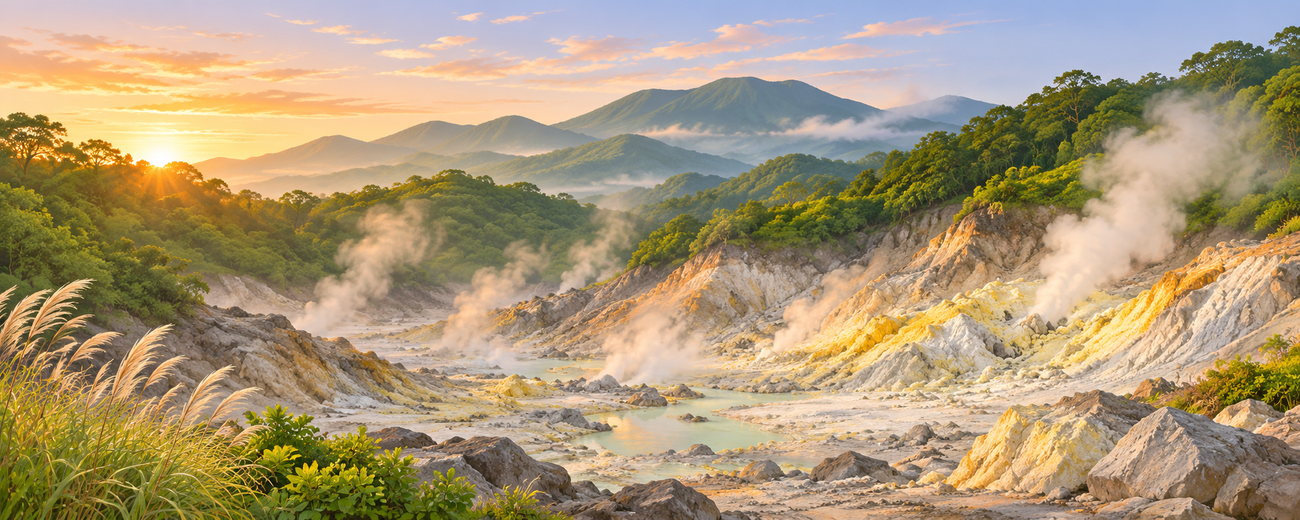
Sulfur Valley is the home of white sulfur. Beside Quanyuan Road, Sulfur Valley is also called Dahuangzui, a volcanic explosion crater. Fumaroles vent across the valley floor, the rock walls are coated in a layer of yellow sulfur crystals, and the air is thick with the smell of sulfur. The white sulfur water here runs at about pH 3 to 5, and the park has a free foot-bath pool, open at present Tuesday to Sunday, 8 in the morning to 6 in the evening.note 2
Thermal Valley is the source of green sulfur. Thermal Valley lies behind Beitou Park. In earlier years the water was so hot and the mist so dense that it was known as Hell Valley; under Japanese rule it was listed among Taiwan's Eight Views and Twelve Scenic Spots under the name "sulfur spring in jade mist".note 4 What rises here is highly acidic green sulfur water, which can approach boiling point. It is for looking at only, not for bathing.
From sulfur mining to soaking: three hundred years of Beitou
The first written records of Beitou are not about hot springs at all. They are about sulfur.
Qing-era sulfur mining (1697): In the thirty-sixth year of the Kangxi reign, Yu Yonghe was sent to Taiwan to mine sulfur, and wrote the sulfur-wreathed valleys around Beitou into his travel account *Pihai Jiyou*, one of the earliest written records of Beitou's sulfur landscape.note 5 Sulfur was gunpowder material at the time, and Beitou was an important place to get it.
A hot spring club and the first inn (late 19th century): In the late 19th century, a German sulfur merchant named Ouely found hot springs in Beitou; in 1896 Hirata Gengo, a Japanese resident, opened Tenguan in Beitou, the area's first privately run hot spring inn.note 4
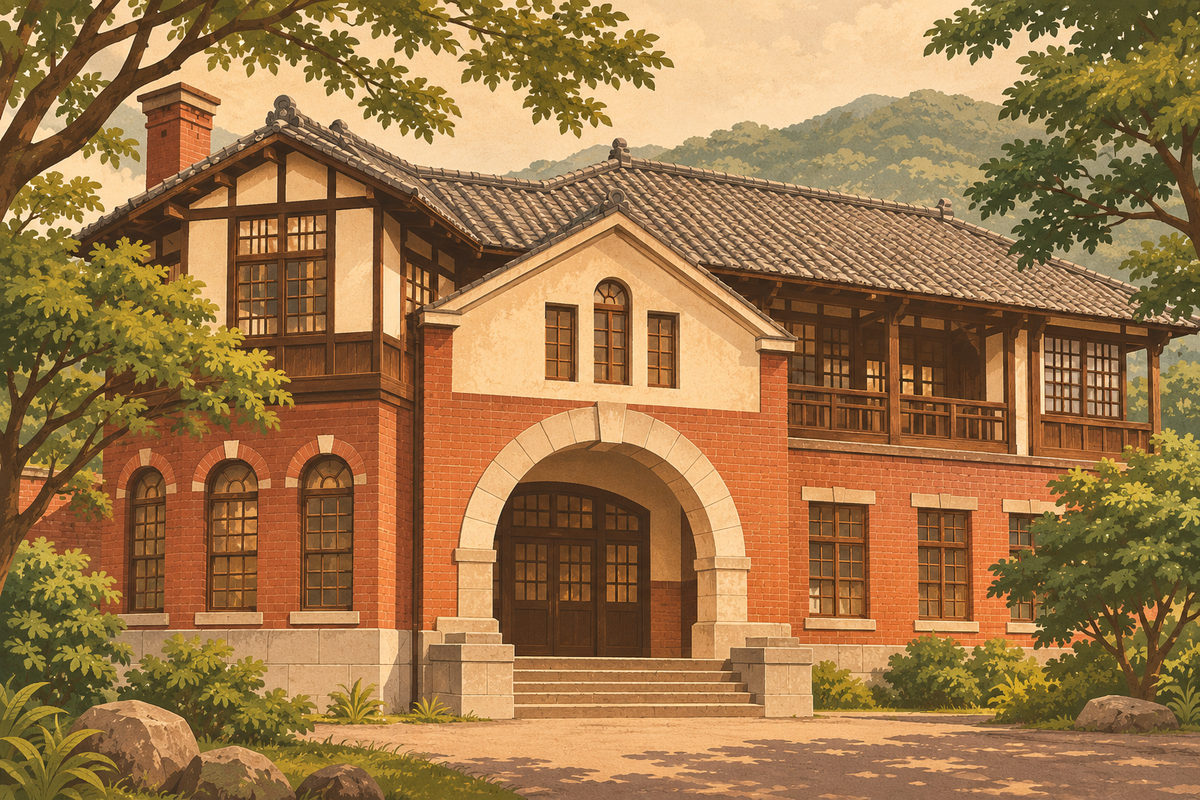
Beitou Hot Spring Bathhouse (1913): The colonial government built a public bathhouse inside Beitou Park, brick baths on the ground floor and wooden rest rooms above, the building that is the Beitou Hot Spring Museum today.note 4
The Xinbeitou branch line (1916): Xinbeitou Station opened, with a railway branch line dedicated to carrying bathers. People called it the bathing line.note 4
The rise and fall of Beitou's bathhouses, and the old baths that remain
Under Japanese rule: soaking becomes everyday life
Japanese residents brought the public bathhouse culture of the sento into Beitou. Public baths, inns and convalescent facilities opened one after another along the Beitou River, and soaking went from a pleasure for the few to an ordinary part of daily life. In 1923, Crown Prince Hirohito visited Beitou during an inspection tour of Taiwan; a commemorative stone still stands in the garden of Longnaitang today.note 6
After the war: nakashi and Beitou's golden years
After the Second World War, Beitou's hot spring inns became gathering places for figures from business and politics, with musicians and singers brought in to entertain, which grew into Beitou's own nakashi culture. Through the 1960s and 1970s, the mix of hot springs, dining and entertainment peaked as a tourism industry and carried a great deal of local employment with it.note 7
After 1979: decline, and being noticed again
In 1979 the government abolished the licensed prostitution system in Beitou, and the busy hot spring tourism that had grown up around it fell away, with many inns closing.note 7 The public bathhouse stood derelict for years, until local residents began a preservation campaign in the 1990s. The old bathhouse was designated a historic site and, once restored, reopened as the Beitou Hot Spring Museum.note 4note 7
Old baths you can still soak in
Longnaitang: In the early years of Japanese rule this was a facility where Japanese troops were treated for injuries, and it later opened to the general public. It is one of the oldest surviving public bathhouses in Beitou and is still trading.note 6
The Sulfur Valley foot-bath pool: The easiest way to try white sulfur is to soak your feet at Sulfur Valley. It is free, no booking, shoes off and sit down.note 2
Why white sulfur is the one people love
Against green sulfur, which is extremely acidic and harsh on the skin, white sulfur is far gentler, and its milky pale yellow water and sulfurous scent are closest to what most people picture when they think of a hot spring. Under Japanese rule, Japanese residents brought the habit of toji with them to Beitou: a hot spring soak was not only washing but a way of resting the body, and Longnaitang began as a bath for treating soldiers.note 6 That idea carried down the generations. Older relatives in Beitou will tell you that a white sulfur soak eases aching joints and stiffness, that you stay warm right through to bedtime, and people with cold hands and feet in winter turn up without fail. These are the lived experience passed down among Beitou families and part of the local culture, and they are why white sulfur holds the place it does in Beitou. They are not product claims and not medical ones.
A side note: the mineral that grows in only two places
Beitou matters not only for its hot springs but for a particular mineral in its riverbed: hokutolite.
Hokutolite is a lead-bearing barite with trace radioactivity.note 8 In the early 20th century the Japanese scholar Okamoto Yohachiro found the mineral in the Beitou River, and it was later formally named hokutolite after the place, the only mineral in the world named after a Taiwanese place name.note 9 As far as is known it occurs only in the Beitou River in Taiwan and at Tamagawa Onsen in Akita Prefecture, Japan.note 8
Hokutolite precipitates slowly in a suitable hot spring environment and builds up on the stones of the riverbed.note 9 It is now very hard to find in the Beitou River, and Taipei City has designated a hokutolite nature reserve under the Cultural Heritage Preservation Act, where collecting is prohibited.note 9
In closing
From the magma chamber beneath the Tatun Volcano Group, to the sulfur-wreathed valleys in Yu Yonghe's writing, to the foot-bath pool at Sulfur Valley today, Beitou's white sulfur spring has come through geological time measured in tens of thousands of years and three hundred years of human history. DaFang 1956 has, since 1956, taken the tanghua that Beitou's white sulfur water leaves behind and made it into hot spring powder, so that a bath of white sulfur can be had at home as well.
Sources
- Academia Sinica. (2019). The Tatun Volcano Group is not frightening; what is frightening is not understanding it [in Chinese]. Academia Sinica Newsletter. https://newsletter.sinica.edu.tw/19194/
- Taipei Water Department. Beitou hot spring water types (pH of white and green sulfur) [in Chinese]. https://www.water.gov.taipei/News_Content.aspx?n=20FD034365D9809C&s=FA14560979875671
- Department of Economic Development, Taipei City Government. Sulfur Valley foot-bath opening hours [in Chinese]. https://hotspringflower.gov.taipei/News_Content.aspx?n=2C76429798774FE6&s=8B71103C1F552972
- Yangmingshan National Park Headquarters, Ministry of the Interior. Hot spring education materials (iron sulfur springs) [in Chinese]. https://ws.moi.gov.tw/Download.ashx?n=5Zau5YWDMeWcqOiPgeWxseiIh%2Ba6q%2BazieebuOa1tC5wZGY%3D&u=LzAwMS9VcGxvYWQvNDUxL3JlbGZpbGUvMTMzODIvMzI0MTg0LzIzMTE0ZTg5LWFiNGMtNDI5Yi1hOTJhLWM5Yzg2ZDg3Mzk1NC5wZGY%3D
- Taipei City Government. Historical records of Beitou hot spring development [in Chinese]. https://www-ws.gov.taipei/001/Upload/public/attachment/37311140437.pdf
- Department of Cultural Affairs, Taipei City Government. Beitou Hot Spring Museum (Beitou Public Bathhouse) heritage profile [in Chinese]. https://culture.gov.taipei/cp.aspx?n=680DE22A4F00B25F
- Yu, Y.-H. (1697). Small Sea Travel Diaries (Pihai jiyou) [in Chinese].
- Beitou Hot Spring Museum. Guide notes on Takinoyu and the Crown Prince Hirohito memorial stone [in Chinese]. https://hotspringmuseum.taipei/service-learning/tourguide/152/
- Taipei City Archives. Research summary on the abolition of licensed prostitution and the Beitou hot spring trade [in Chinese]. https://www.chr.gov.taipei/News_Content.aspx?n=E0A330A4F72C3F6E&s=DBF920A9FF3AA239
- Geological Survey and Mining Management Agency, Ministry of Economic Affairs. Geology encyclopedia: Hokutolite [in Chinese]. https://twgeoref.gsmma.gov.tw/GipOpenWeb/wSite/ct?ctNode=1233&mp=105&xItem=125846
Notes
note 1: Lin Cheng-Horng's team at the Institute of Earth Sciences, Academia Sinica, used seismic data to show a magma chamber beneath the Tatun Volcano Group; the team stated that the most recent eruption was around five to six thousand years ago. Academia Sinica Newsletter (2019), "The Tatun volcanoes are not to be feared; what is to be feared is not understanding them". https://newsletter.sinica.edu.tw/19194/
note 2: Taipei Water Department lists white sulfur at pH 3 to 5; the Department of Economic Development, Taipei City Government announces that the Sulfur Valley foot-bath pool is at present open Tuesday to Sunday, 8 in the morning to 6 in the evening. https://www.water.gov.taipei/News_Content.aspx?n=20FD034365D9809C&s=FA14560979875671;https://hotspringflower.gov.taipei/News_Content.aspx?n=2C76429798774FE6&s=8B71103C1F552972
note 3: Taipei Water Department lists green sulfur at about pH 1 to 2; the Yangmingshan National Park educational material from the Ministry of the Interior lists iron sulfur at pH 6 to 7, distributed mainly around Mount Shamao and the Shuangchongxi area. https://www.water.gov.taipei/News_Content.aspx?n=20FD034365D9809C&s=FA14560979875671;https://ws.moi.gov.tw/Download.ashx?n=5Zau5YWDMeWcqOiPgeWxseiIh%2Ba6q%2BazieebuOa1tC5wZGY%3D&u=LzAwMS9VcGxvYWQvNDUxL3JlbGZpbGUvMTMzODIvMzI0MTg0LzIzMTE0ZTg5LWFiNGMtNDI5Yi1hOTJhLWM5Yzg2ZDg3Mzk1NC5wZGY%3D
note 4: Taipei City historical records document Ouely's discovery of the Beitou hot springs in the late 19th century, Hirata Gengo's opening of Tenguan in 1896, and the building of the Xinbeitou branch line in 1916; the Department of Cultural Affairs, Taipei City Government records that the Beitou public bathhouse was built in 1913 and reopened in 1998 as the Beitou Hot Spring Museum. https://www-ws.gov.taipei/001/Upload/public/attachment/37311140437.pdf;https://culture.gov.taipei/cp.aspx?n=680DE22A4F00B25F
note 5: Yu Yonghe, *Pihai Jiyou*, the thirty-sixth year of the Kangxi reign, Qing dynasty (1697).
note 6: The Beitou Hot Spring Museum records that Longnaitang was originally a facility for treating injured Japanese troops and later opened to the general public; the same museum records Crown Prince Hirohito's 1923 visit to Beitou, with the commemorative stone now kept in the garden of Longnaitang. https://hotspringmuseum.taipei/;https://hotspringmuseum.taipei/service-learning/tourguide/152/
note 7: A research summary from the Taipei City Archives records that after the government abolished the licensed prostitution system in Beitou in 1979, the local hot spring trade declined with it. https://www.chr.gov.taipei/News_Content.aspx?n=E0A330A4F72C3F6E&s=DBF920A9FF3AA239
note 8: The GeoEncyclopedia of the Geological Survey and Mining Management Agency, Ministry of Economic Affairs, states that hokutolite is a radioactive lead-bearing barite, and that the only known occurrences are the Beitou River and Tamagawa Onsen in Akita Prefecture, Japan. https://twgeoref.gsmma.gov.tw/GipOpenWeb/wSite/ct?ctNode=1233&mp=105&xItem=125846
note 9: Government sources differ on the year hokutolite was found, between 1905, 1906 and 1907, depending on how first sighting and confirmation are defined; this article gives it as the early 20th century. The GeoEncyclopedia of the Geological Survey and Mining Management Agency, Ministry of Economic Affairs, records that hokutolite precipitates and adheres to riverbed stones in a suitable hot spring environment, and sets out its naming and its current protection. https://twgeoref.gsmma.gov.tw/GipOpenWeb/wSite/ct?ctNode=1233&mp=105&xItem=125846
Further reading
- People Who Bathe Daily Have 28% Lower Cardiovascular Disease Risk — Japan's 20-Year Cohort of 30,076 Adults
- Cold Hands and Feet Keeping You Awake? The Science of Peripheral Circulation and the Pre-Sleep Footbath
- Warm Feet Matter? Does Cold Feet Really Bring On a Cold? Staying Warm When a Cold Is Coming On and the Nose Is Blocked: Foot Baths, Hot Baths and Steam