

Other language versions: 繁體中文 · 日本語
The short version
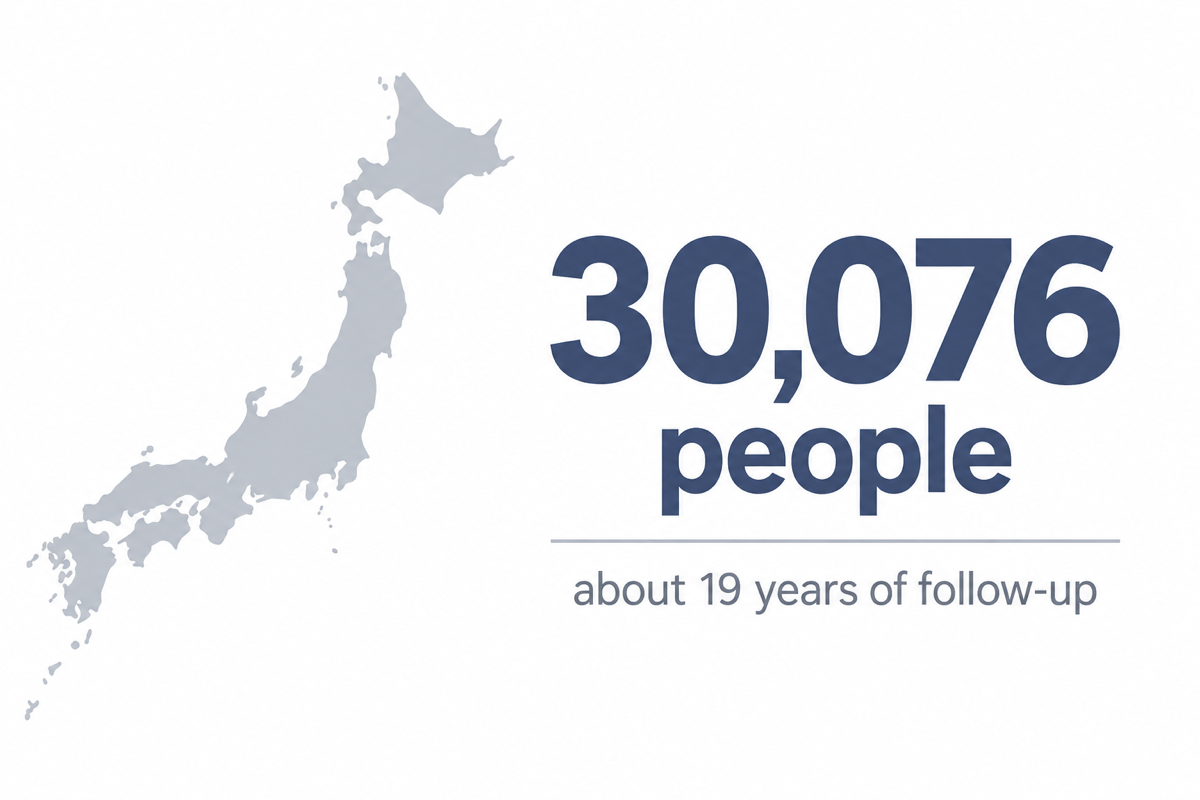
A Japanese prospective cohort study published in Heart in 2020 followed 30,076 adults for about 19 years. Among those who bathed in a tub almost every day, the overall incidence of cardiovascular disease (CVD; written out as "cardiovascular disease" throughout this article) carried a hazard ratio (HR) of 0.72 against people who bathed 0 to 2 times a week — roughly 28% lower.¹
This is an observational study, and that design cannot by itself establish cause and effect. Its scale and its follow-up time, though, are unusual among studies of this kind anywhere in the world. What follows gathers the core figures from seven studies as their original papers report them, setting out the correlations observed between bathing frequency and cardiovascular measures, along with the limits that come with them.
How the Japanese cohort was built: 30,076 people, nearly 20 years
Ukai and colleagues (2020) worked from the JPHC data set (the Japan Public Health Center-Based Prospective Study), analysing 30,076 middle-aged and older Japanese adults. At baseline, every participant was asked how often they took a tub bath, and answers were grouped three ways: 0 to 2 times a week, 3 to 4 times a week, and almost every day. Over the follow-up period the study recorded 2,097 cardiovascular events, coronary heart disease and stroke among them.¹
Mean follow-up ran to about 19 years, making this one of the largest long-term cohort studies in the field. All analyses were adjusted for the main confounders: age, sex, smoking, alcohol, BMI, exercise habits and history of diabetes.
The fundamental limitation sits in the observational design. Bathing frequency was self-reported, and neither the water temperature nor the length of each bath could be confirmed. Beyond that, people who bathe daily may simply keep more regular habits across the board, and those habits are hard to separate cleanly from cardiovascular health.¹
What the data show on daily bathing and cardiovascular risk
For the primary outcomes, the almost-every-day group compared against the 0-to-2-times-a-week group looked like this:
| Outcome | Hazard ratio (HR) | In plain terms |
|---|---|---|
| Overall cardiovascular disease incidence | 0.72 | About 28% lower |
| Stroke | 0.74 | About 26% lower |
(95% confidence intervals are given in note 1.)
These figures need reading with care. An HR below 1 means that group had a lower event rate over the follow-up period — but this is an observational association, and it does not mean the act of bathing caused the difference. The authors raise the point themselves in their discussion: people who are in better health to begin with may have more room in their lives to keep up a daily bath, and this "healthy user bias" makes the association look stronger than it is.¹
A Finnish study (Laukkanen et al., 2015) followed 2,315 men for 20.7 years and likewise found an association between frequent sauna use and cardiovascular mortality: for men using a sauna 4 to 7 times a week, the hazard ratio for sudden cardiac death (SCD) was 0.37 against men using one once a week.² That study is about the Finnish dry sauna, which differs from the Japanese hot tub in heating medium, in temperature and in how the body meets the heat. The two cannot be read across directly.
Arterial elasticity and cardiac load, measured on their own terms
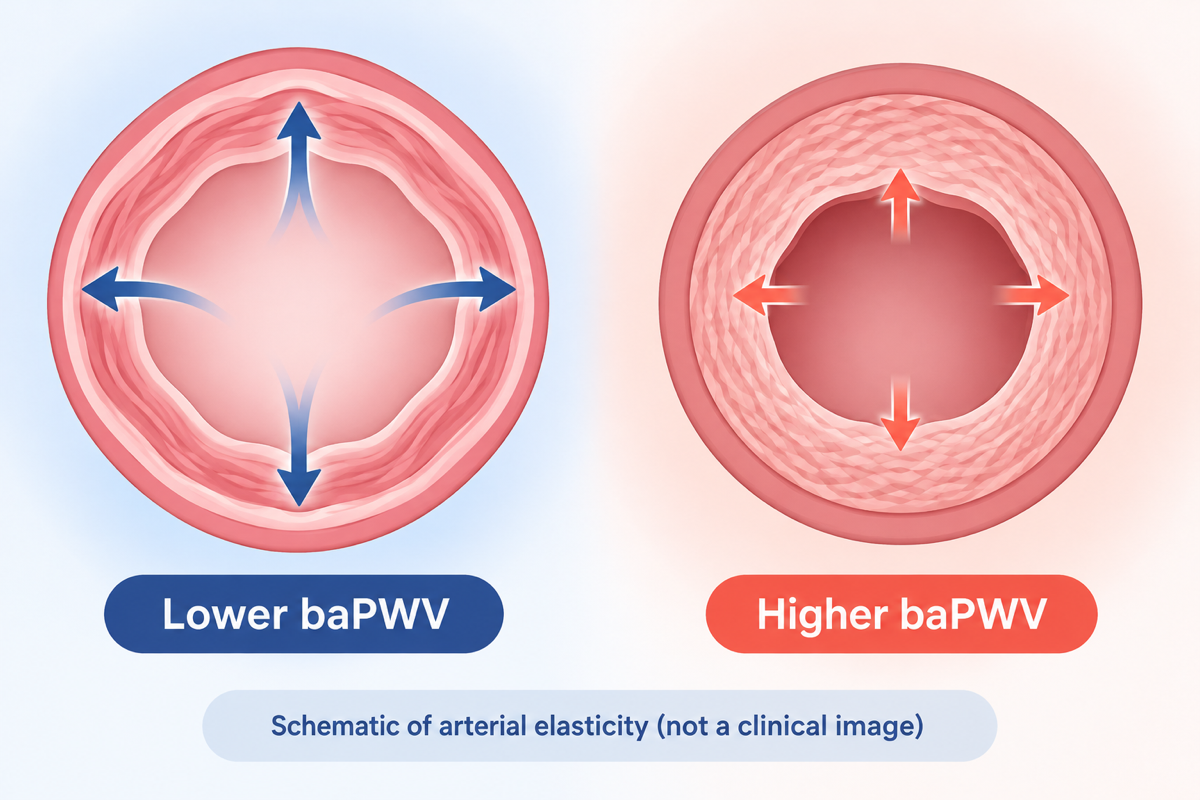
Kohara and colleagues (2018) came at the question from a different angle, measuring the correlation between bathing habits and markers of vascular elasticity rather than taking cardiovascular events as the endpoint.
The study measured three numbers in 873 middle-aged and older Japanese adults: how stiff the arteries are (brachial-ankle pulse wave velocity, baPWV), how much strain the heart is under (BNP), and the gap between systolic and diastolic pressure (pulse pressure). People bathing 5 or more times a week had lower readings on all three.³
Lower readings here point to better vascular elasticity and a lighter load on the heart. But this is a single measurement taken at one point in time, which cannot tell us whether bathing improved the vessels or whether people whose vessels were in good shape to begin with bathe more often. Differences in overall lifestyle sit inside that result too.
Why hot water might affect blood vessels
The explanation the authors offer runs like this: sitting in hot water dilates the vessels near the skin and speeds up blood flow, and the inner wall of the vessel, meeting that stimulus again and again, may hold its elasticity better for it.³ That remains a proposed mechanism. Kohara's own study can say only that people who bathe often have better readings on these measures; it cannot show that bathing is what produced them.
Can heat therapy lower blood pressure? What the clinical trials show
The limits of observational work pushed researchers towards randomised controlled trials (RCTs), which test the question — does a hot bath change blood pressure? — more directly.
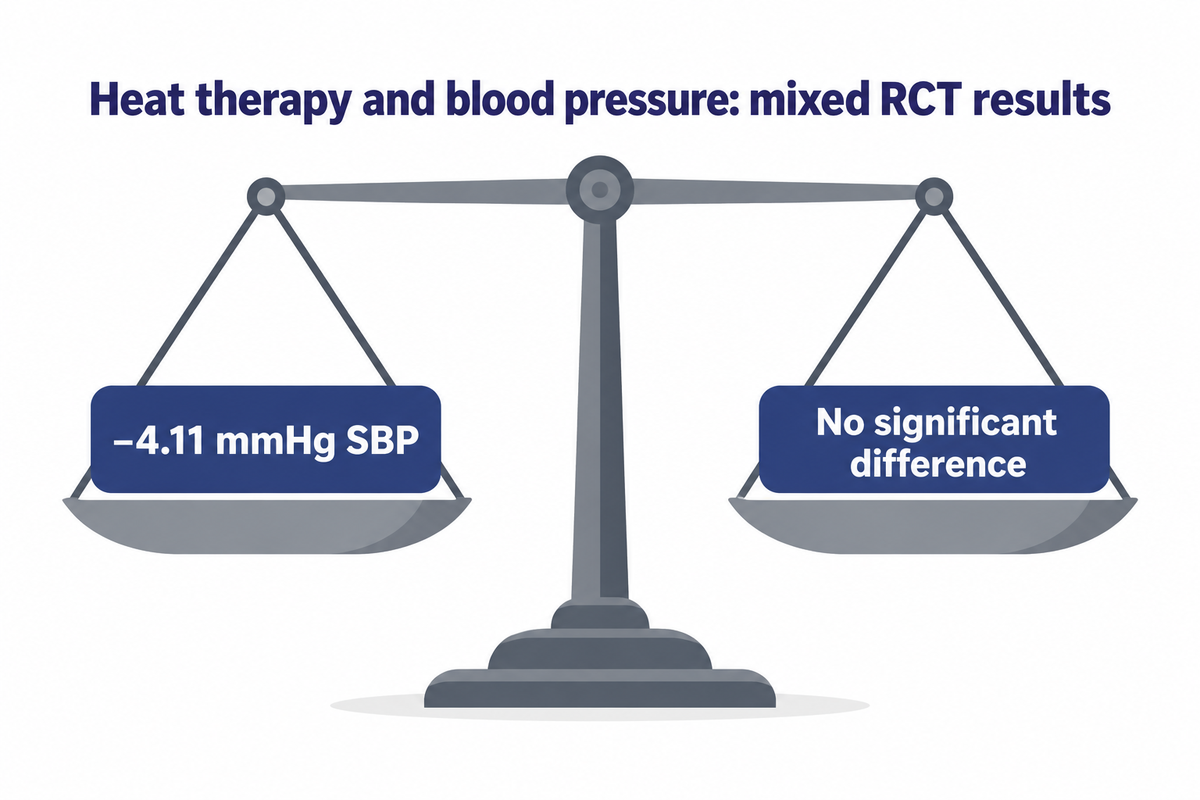
Hamaya and colleagues (2025) pooled 20 RCTs with intervention periods of 2 to 15 weeks to analyse the effect of bathing or heat therapy on blood pressure. The overall conclusion: most of the primary and secondary endpoints did not reach statistical significance. In the subgroup analysis confined to whole-body heating, systolic pressure fell by an average of −4.11 mmHg, which did reach significance — but heterogeneity between studies (I²) was high, and how robust that result is remains for later work to confirm.⁴
Kaiser and colleagues (2025) randomised 41 adults with untreated hypertension into a heat therapy group (21 people) and an aerobic exercise group (20 people), each completing 30 sessions over 8 to 10 weeks. In the heat therapy group, 24-hour systolic pressure read 134 mmHg before and 134 mmHg after — no change. The exercise group was the same.⁵ For anyone who had hoped to bring their blood pressure down through heat, that is a result worth sitting with.
Leaney and colleagues (2026) tested the acute effect of a single 60-minute hot water immersion at 40.4°C in 23 healthy adults. The nocturnal dip in diastolic pressure deepened from 15.4% to 19.1% — the night-time fall in blood pressure became more pronounced — while 24-hour mean blood pressure showed no significant change.⁶ The effect of one acute exposure and whatever regular heat exposure might accumulate over the long run are two different things, and need keeping apart when drawing conclusions.
Taken together, the intervention research so far does not support the stronger claim that a hot bath can effectively lower blood pressure in people with chronic hypertension.
The safety boundaries of bathing: where extra care is needed
Alongside the observational benefits, safety deserves the same level of attention.
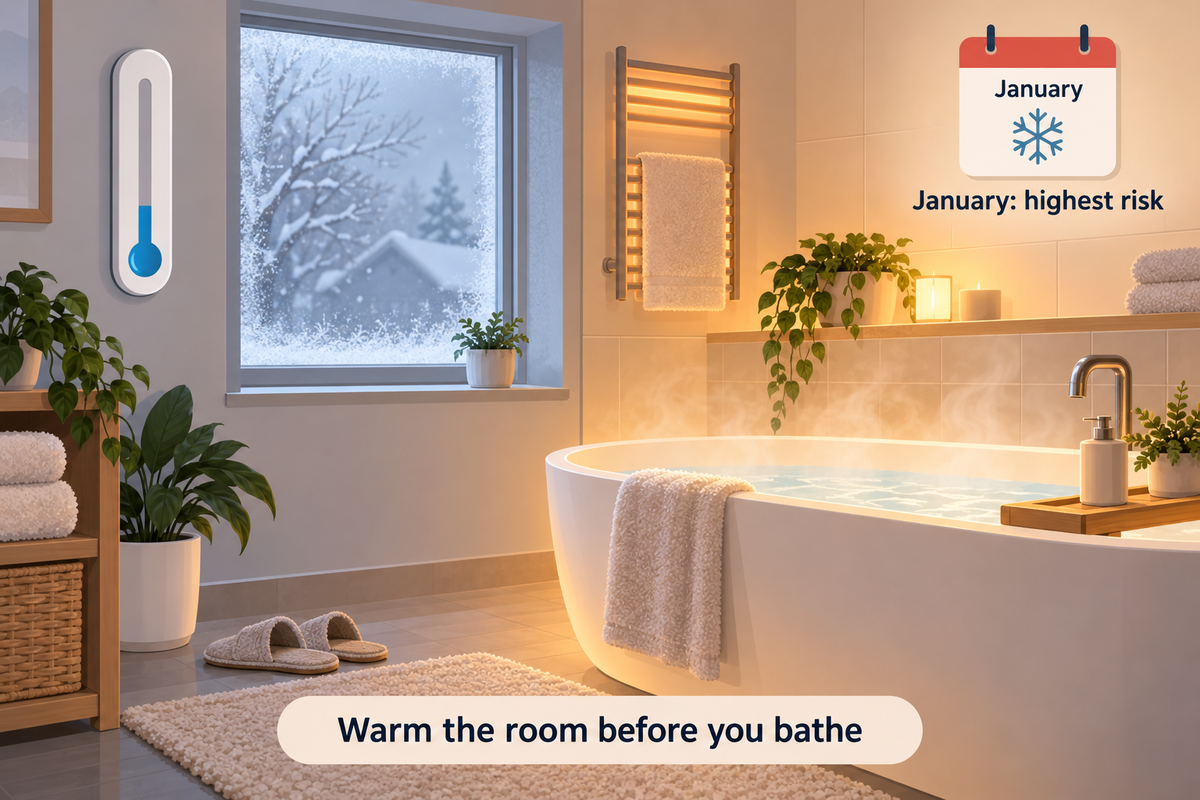
Tai and colleagues (2025) analysed 99,930 bathtub drowning deaths recorded in Japan between 1995 and 2020 and found several clear risk features: incidence peaked in January, and within the age strata, deaths were most numerous at 80 to 84 years old.⁷
For older people, and for anyone with a circulatory condition, the risks of bathing do not disappear because an observational association exists. If you have cardiovascular disease, talk to a doctor first and settle on a suitable temperature, duration and frequency before building the habit.
Translated into what that means in an ordinary home bathroom, it comes down to a handful of things:
- In winter, warm the bathroom before you undress: January carries the highest risk, and the problem is not the water — it is the swing from a cold bathroom into hot water. Running a heater, or letting the hot tap steam the room up first, both narrow that gap.
- When an older relative is bathing, stay within earshot: 80 to 84 is the highest-risk age band. Leaving the door unlocked, and knocking if the room has gone quiet for a while, are more use than any temperature advice.
- Don't bathe after drinking: alcohol and hot water both dilate the vessels and lower blood pressure, and stacked together they make light-headedness more likely.
- Get out slowly: your vessels are dilated and your blood pressure is on the low side, so standing up fast invites dizziness. Sit on the rim for a few seconds first.
- Drink water before and after: a hot bath makes you sweat more than you would think.
For how to judge water temperature and timing, see our earlier guide, How Warm Is a 41°C Footbath? Water Temp, Timing & a 10-Minute Pre-Sleep Ritual — the same principles apply to a full bath.
Frequently asked questions
Q: Does "28% lower" mean a daily bath will prevent heart disease?
No. The figure comes from an observational study, and what it reflects is that people who bathed daily had a lower rate of cardiovascular disease over nearly 19 years of follow-up — the study design cannot confirm cause and effect. It may be a physiological effect of the bathing habit itself; it may equally be that people who bathe habitually already have a healthier overall lifestyle. There is not yet enough randomised controlled trial evidence to support the causal claim that daily bathing prevents cardiovascular disease.
Q: Can sauna findings and bathing findings be used interchangeably?
Reading one across to the other is not advisable. The Finnish sauna study by Laukkanen and colleagues (2015) looked at a dry heat environment, which differs from a hot tub in heating medium, temperature gradient and the body's response. Some of the physiology overlaps — peripheral vasodilation, for one — but the figures cannot be borrowed between them.
Q: I have high blood pressure. Can a hot bath improve it?
The clinical trial results so far point the cautious way. Kaiser and colleagues (2025) ran a 30-session heat therapy intervention in people with untreated hypertension and found no significant improvement in blood pressure. The meta-analysis by Hamaya and colleagues (2025) likewise showed most endpoints falling short of significance. If you have cardiovascular disease or hypertension, talk to a doctor first; bathing should not be treated as a substitute for managing blood pressure.
Q: Who needs to take particular care when bathing?
The data from Tai and colleagues (2025) show bathtub drowning deaths concentrated at 80 to 84 years old and peaking in January. An environment with too sharp a temperature gap — cold bathroom into hot tub — may provoke an acute cardiovascular response. If you have heart disease, hypertension or cerebrovascular disease, talk to a doctor first.
Further reading
- How Warm Is a 41°C Footbath? Water Temp, Timing & a 10-Minute Pre-Sleep Ritual
- Cold Hands and Feet Keeping You Awake? The Science of Peripheral Circulation and the Pre-Sleep Footbath
- No Bathtub? No Problem. A Complete Guide to Foot Baths, Half Baths, and Full Baths with Beitou White Sulfur Powder
- Sleepy Earlier, Awake at Four? How Autumn's Shorter Days and Cooler Nights Actually Affect Sleep
Sources
-
Ukai T, Iso H, Yamagishi K, et al. Habitual tub bathing and risks of incident coronary heart disease and stroke. Heart. 2020;106(10):732–737. https://doi.org/10.1136/heartjnl-2019-315752 (PMID 32209614)
-
Laukkanen T, Khan H, Zaccardi F, Laukkanen JA. Association between sauna bathing and fatal cardiovascular and all-cause mortality events. JAMA Intern Med. 2015;175(4):542–548. (PMID 25705824)
-
Kohara K, Tabara Y, Ochi M, et al. Habitual hot water bathing protects cardiovascular function in middle-aged to elderly Japanese subjects. Sci Rep. 2018;8:8687. https://doi.org/10.1038/s41598-018-26908-1 (PMID 29930309)
-
Hamaya R, Joyama Y, Miyata T, et al. Non-acute effects of passive heating interventions on cardiometabolic risk and vascular health: systematic review and meta-analysis of randomized controlled trials. Am J Prev Cardiol. 2025. https://doi.org/10.1016/j.ajpc.2025.101082 (PMID 41049507)
-
Kaiser BW, Comrada LN, Gibson BM, et al. No effect of either heat therapy or aerobic exercise training on blood pressure in adults with untreated hypertension: a randomized clinical trial. J Appl Physiol. 2025. https://doi.org/10.1152/japplphysiol.00959.2024 (PMID 40407037)
-
Leaney SF, Ponce FAF, Owen TF, et al. Acute hot-water immersion augments the diastolic blood pressure nocturnal dip in healthy adults. Exp Physiol. 2026. https://doi.org/10.1113/ep093583 (PMID 41801255)
-
Tai Y, Obayashi K, Yamagami Y, Saeki K. Drowning and submersion deaths in bathtubs and associated factors: a descriptive and ecological study in Japan, 1995–2020. J Epidemiol. 2025. https://doi.org/10.2188/jea.JE20250032 (PMID 40383633)
Notes
¹ Ukai 2020: JPHC prospective cohort study; 30,076 people, about 19 years of follow-up, 2,097 cardiovascular events (CVD = cardiovascular disease, coronary heart disease and stroke included). The 95% confidence intervals for the two outcomes: 0.62–0.84 for overall incidence, 0.62–0.87 for stroke. Bathing frequency was self-reported at baseline and grouped three ways (0–2 times a week / 3–4 times a week / almost every day), with 0–2 times a week as the comparison group; water temperature and duration were not recorded. The observational design cannot rule out residual confounding (lifestyle, socioeconomic position, health-seeking behaviour), and no description of an "association" here amounts to causation.
² Laukkanen 2015: 2,315 middle-aged Finnish men followed for 20.7 years. The subject is the dry sauna, which differs from whole-body immersion in a hot tub in heating medium, temperature gradient and mode of exposure — worth keeping in mind when reading the figures.
³ Kohara 2018: cross-sectional analysis of 873 middle-aged and older Japanese adults (with a further 164 followed longitudinally). The markers are baPWV, BNP and pulse pressure, not disease events; a cross-sectional design cannot establish direction. The mechanism described under "Why hot water might affect blood vessels" is taken from that paper's discussion and is the authors' proposal, not a measurement made in the study.
⁴ Hamaya 2025: meta-analysis of 20 RCTs (hot water bathing, sauna, hot yoga, local heating; 2 to 15 weeks). Most endpoints did not reach statistical significance: systolic pressure overall came to −2.46 mmHg (95% CI −5.02 to 0.10, I² = 60.3%), not significant, while the whole-body heating subgroup came to −4.11 mmHg (95% CI −7.36 to −0.86). Heterogeneity was high and the results need cautious interpretation.
⁵ Kaiser 2025: 41 adults with untreated hypertension (aged 48), randomised to heat therapy (21) or aerobic exercise (20), 30 sessions each over 8 to 10 weeks. In the heat therapy group, 24-hour systolic pressure went 134 → 134 mmHg (P = 0.81), with no difference between the groups either. The trial had no non-intervention control group.
⁶ Leaney 2026: 23 healthy adults, a single 60-minute hot water immersion at 40.4°C. The nocturnal dip in diastolic pressure went from 15.4% to 19.1%; 24-hour mean blood pressure showed no significant change. An acute effect is not a long-term effect.
⁷ Tai 2025: 99,930 bathtub drowning deaths in Japan, 1995–2020; January highest, 80 to 84 years old most numerous. The study is a descriptive and ecological analysis of national death certificates and did not analyse individual factors such as alcohol.