

Other language versions: 繁體中文 · 日本語
The short version
Turning over on a winter night with toes that never warm up — a lot of people know the feeling. The usual explanation is "a cold constitution" or "bad circulation", but what is actually happening physiologically? Why might a footbath help? And what concrete numbers do the clinical studies give us?
This article starts from how the peripheral blood vessels are regulated, gathers the existing research evidence, and sets out the physiological route by which a footbath taken before bed may affect how quickly you fall asleep.
A falling core body temperature is the signal that starts sleep
Many people assume that falling asleep runs on accumulated tiredness. Sleep science points to another important trigger: an active drop in core body temperature.
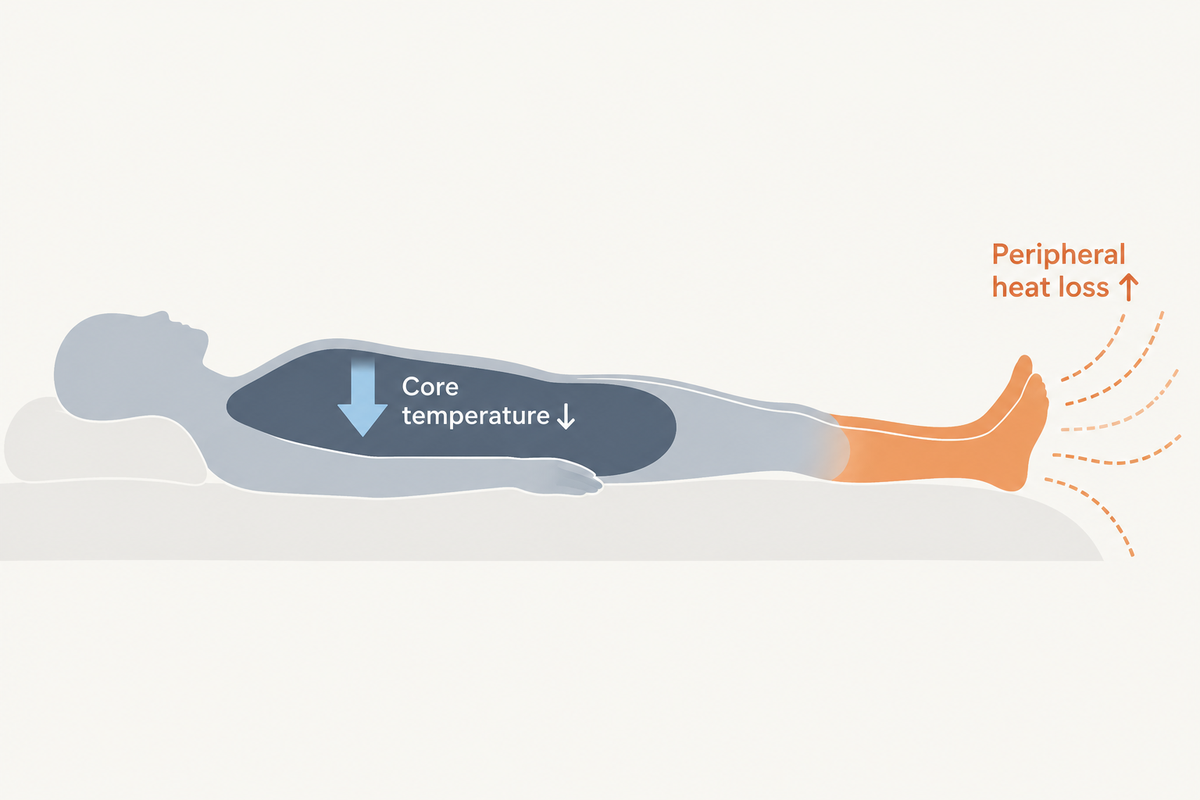
Core body temperature at night normally sits below its daytime level, and part of how that fall is achieved is peripheral vasodilation, shedding heat outward. As skin temperature at the hands and feet rises and heat is carried away, core temperature follows it down; the brain registers the downward signal and the sleep machinery starts up.
Kräuchi and colleagues (1999), writing in Nature, described exactly this route: when the temperature gradient between distal and proximal skin (the distal-proximal skin temperature gradient, or DPG) widens, it indicates more heat being shed at the periphery, and this is associated with a shorter sleep latency.¹ Put plainly, warm feet help the body move heat from the inside out, assisting the fall in core temperature and smoothing the way into sleep.
In people with cold hands and feet, the peripheral vessels may sit in a constricted state much of the time, heat is shed less efficiently, and core temperature has more trouble coming down. Mechanistically, that goes some way towards explaining why people with cold extremities so often sleep badly.
The clinical evidence on footbaths and sleep quality
Reasoning at the level of mechanism has to be tested in clinical trials. In 2025, Chang and colleagues published a systematic review and meta-analysis in the Scandinavian Journal of Caring Sciences pooling 18 studies and 950 participants aged 60 and over, of whom 52.3% were women.²
The overall effect of footbath interventions on sleep quality came out at SMD = −0.76 (95% CI: −1.22 to −0.29). By statistical convention, an effect size (SMD) beyond −0.5 is generally read as moderate to moderately large; this result falls in that range, and the confidence interval sits entirely below zero, meaning the improvement is statistically significant.
Those 18 studies span different intervention protocols and different measurement instruments, and the fairly wide confidence interval (−1.22 to −0.29) reflects that heterogeneity. The direction, though, is consistent: footbaths have a positive effect on sleep quality in this age group.
A year earlier, Nasiri and colleagues (2024) published a systematic review of footbaths in older adults in BMC Geriatrics, taking in 10 studies, 9 of which reported a positive effect on sleep.³
What temperature, how long, over how many weeks?
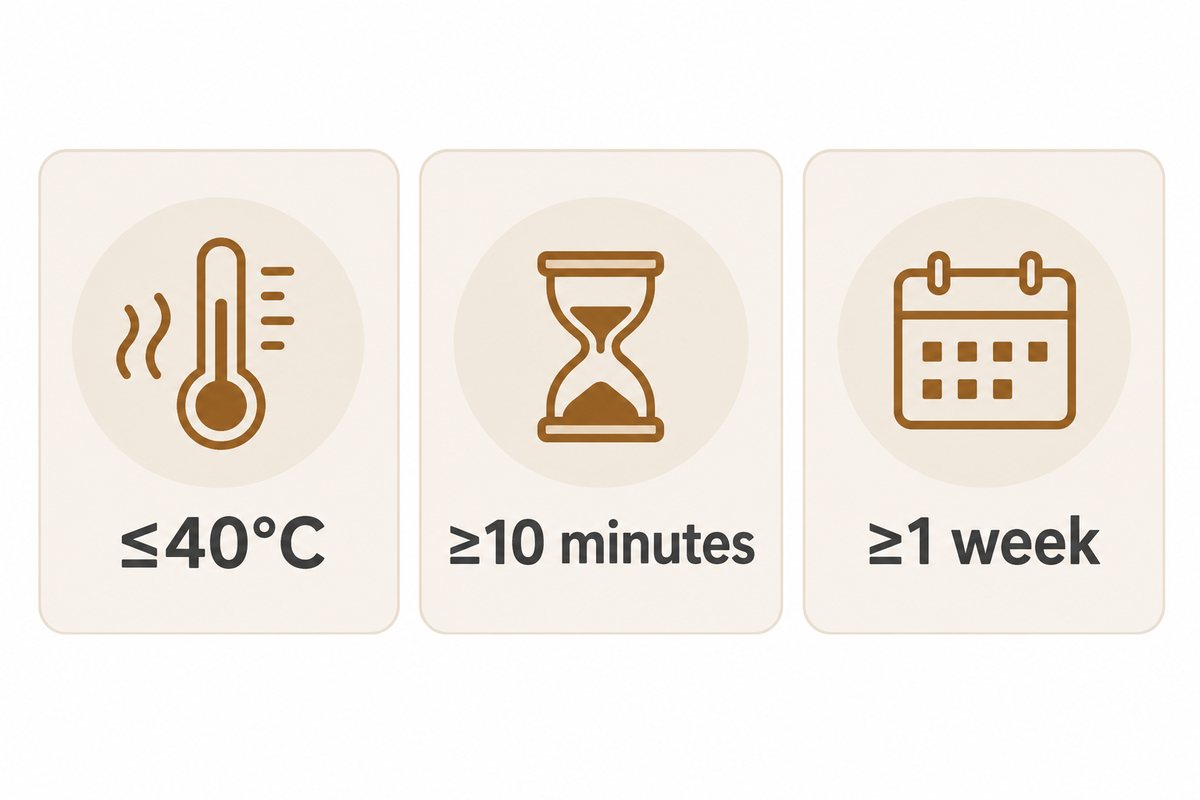
The Chang et al. (2025) meta-analysis does not only answer "does a footbath work". It also ran a moderator analysis on how the intervention is carried out, and drew out the combination of parameters associated with the clearest improvement in sleep:
| Parameter | Best range identified in the research |
|---|---|
| Water temperature | ≤ 40°C |
| Duration per session | ≥ 10 minutes |
| Intervention period | ≥ 1 week |
Each of the three is worth taking separately.
Water temperature ≤ 40°C: the intuition is often that hotter works better, but the pooled data point to a warm rather than hot range. Set against that, most of the studies gathered by Nasiri and colleagues (2024) used water above 40°C and also observed improvement; read side by side, the two reviews put the usual range at around 40°C — warm, not scalding.³ For the practical detail on getting the temperature right, see our How Warm Is a 41°C Footbath? Water Temp, Timing & a 10-Minute Pre-Sleep Ritual.
Duration ≥ 10 minutes: a brief dip may not be enough for the peripheral vessels to finish dilating and for skin temperature to rise sufficiently, which takes the edge off the effect. Ten minutes is the lowest threshold the current research supports.
Intervention period ≥ 1 week: in the subgroup analysis in Chang et al. (2025), groups running a week or more showed better results; this does not mean that under a week has no effect.
All three conditions met together is what comes closest to the conditions the studies were run under.
Who does this research apply to?
The population in the Chang et al. (2025) meta-analysis was specified as older adults aged 60 and over. Which means:
- If you fall in that age group and have trouble getting to sleep or unstable sleep quality, the existing research speaks most directly to you.
- If you are a younger adult, there is less direct research in the literature; but the DPG mechanism Kräuchi (1999) described is not, as basic physiology, confined to older people.¹
This article is also about sleep quality in the general population. If you have a specific medical condition, speak to a doctor first, and do not use a footbath in place of medical treatment.
Putting a footbath into practice
Working from the parameters the research identifies, a pre-sleep footbath takes a fairly concrete shape:
- Start getting ready 30 to 60 minutes before bed, so thermoregulation has time to run its course
- Use a clean footbath basin, with enough water to cover the ankles
- Keep the water below 40°C (check with a thermometer, or test on the inside of your wrist for "warm, not scalding")
- Soak for 10 minutes or more
- Dry off afterwards and put on warm cotton or wool socks
If you use a mineral bath powder, bear in mind that the clinical literature here evaluates the effect of the footbath intervention as a whole; whether a particular formulation adds anything to sleep would need its own study design to establish. DaFang 1956's Beitou white sulphur hot spring powder has natural spring-flower crystals (hot spring crystals) as its sole raw material, which makes it a reasonable companion to a footbath — but the research figures in this article should not be taken as evidence of a product effect.
In short
Cold hands and feet affecting sleep has a physiological basis: too little heat shed at the periphery, a core temperature that struggles to come down, and a delayed start signal for sleep. As a simple, low-risk intervention, footbaths showed a moderate improvement in sleep quality (SMD = −0.76) in a meta-analysis of 18 studies and 950 participants.
The conditions that work best are not complicated: water ≤ 40°C, 10 minutes or more, kept up for a week or more. Meeting all three together is what comes closest to the conditions in the research.
Further reading
- How Warm Is a 41°C Footbath? Water Temp, Timing & a 10-Minute Pre-Sleep Ritual
- No Bathtub? No Problem. A Complete Guide to Foot Baths, Half Baths, and Full Baths with Beitou White Sulfur Powder
- How to Do a Relaxing Foot Bath Before Bed: Water Temp, Timing & Steps
- Sleepy Earlier, Awake at Four? How Autumn's Shorter Days and Cooler Nights Actually Affect Sleep
- You Slept In All Weekend — So Why Are You Still Tired on Monday? The Science of Sleep Debt, Social Jet Lag & Your Body Clock
Sources
-
Kräuchi, K., Cajochen, C., Werth, E., & Wirz-Justice, A. (1999). Warm feet promote the rapid onset of sleep. Nature, 401, 36–37. https://doi.org/10.1038/43366
-
Chang, S.-Y., Lee, Y.-C., Hung, H.-Y., Chen, C.-T., Fang, C.-J., & Chen, Y.-C. (2025). A systematic review and meta-analysis of footbath effects and optimal procedures to improve sleep in older adults. Scandinavian Journal of Caring Sciences, 39(3). https://doi.org/10.1111/scs.70118 (PMID 40973991)
-
Nasiri, K., Shriniy, M., Pashaki, N. J., Aghamohammadi, V., Saeidi, S., Mirzaee, M., Soodmand, M., & Najafi, E. (2024). The effect of foot bath on sleep quality in the elderly: A systematic review. BMC Geriatrics, 24, 191. https://doi.org/10.1186/s12877-023-04590-x (PMID 38408926)