
The short version (30-second read)
- A hot spring and a hot bath are not the same experience — and the difference is not only about "whether there are minerals."
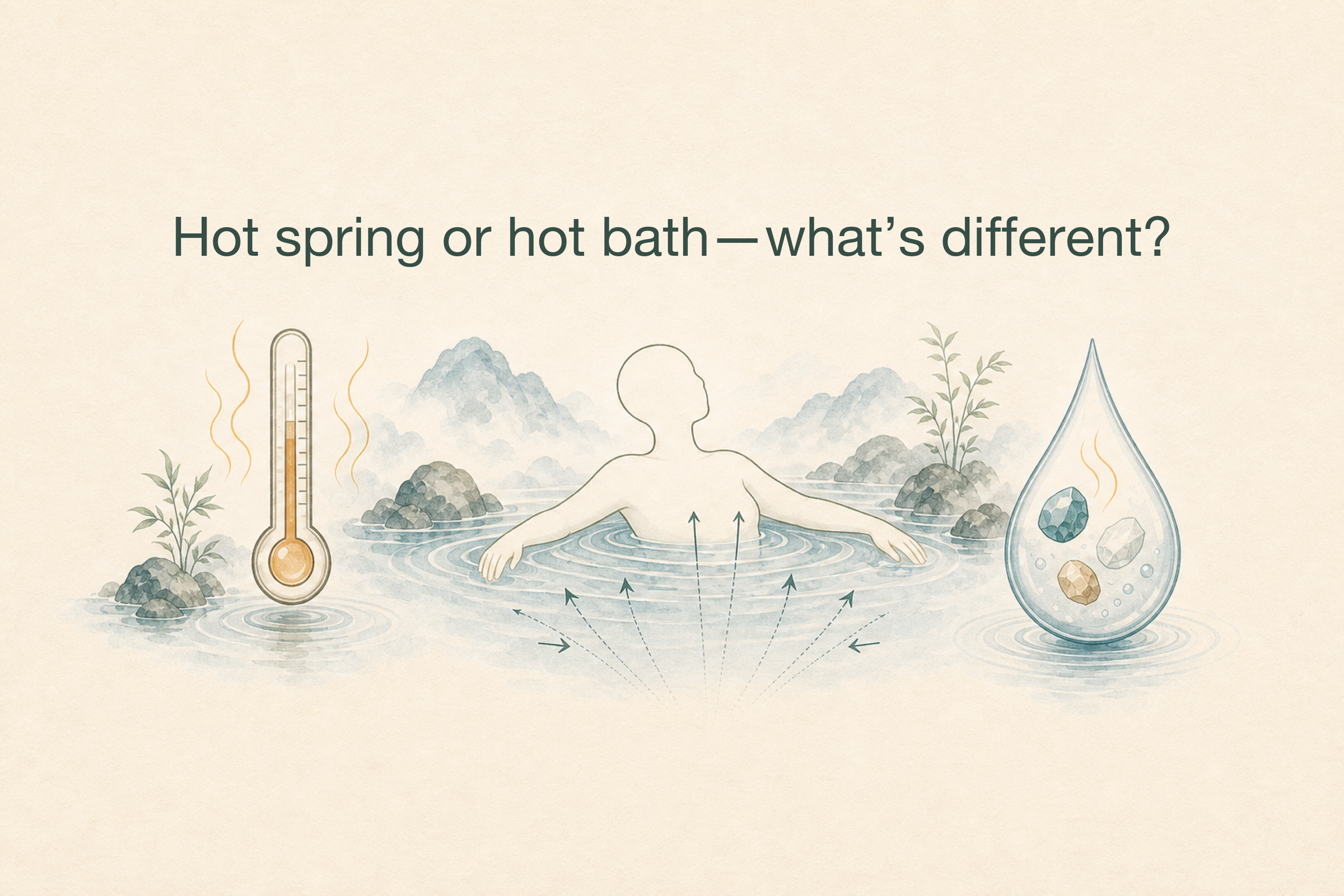
- The clearest way to see it is in three layers: heat, being in the water (buoyancy and pressure), and what's in the water (minerals, smell, texture).
- Research still can't cleanly separate the isolated effect of the minerals from heat, immersion, environment, rest and expectation — but that doesn't mean the two are the same.
- The physics of heat and of being in the water explain part of a real physiological difference; and smell, setting, culture and ritual also genuinely shape how a soak feels.
- Across national surveys, many people describe a hot spring as a different kind of relaxation from an ordinary hot bath — that subjective feeling is part of the experience. It isn't fake, but it also isn't proof of a treatment effect.
- More useful than "which one is more effective" is making the soak itself safe.
A lot of people ask: when you soak in a hot spring versus taking a hot bath at home, does the body really feel the same? The more honest answer is — not entirely, and the difference doesn't come only from minerals. Research still struggles to fully separate the isolated effect of the minerals from heat, immersion, environment and expectation; but that doesn't mean the two experiences are identical. Science can explain part of the physiological difference (the effects of heat and of being in the water), while the senses, the setting and the sense of ritual also genuinely affect how a soak feels. This article separates the three layers cleanly, and uses verifiable surveys from several countries to look at how people actually describe it.
1. First, separate three things: heat, being in the water, and what's in the water
"Soaking in a hot spring" is really three things happening at once, and any comparison has to pull them apart so the credit doesn't get assigned to the wrong layer:
- Heat: warm water dilates the blood vessels at the skin and changes circulation — a hot bath does this too.
- Being in the water: when your whole body is immersed, it meets the buoyancy of the water (which takes weight off the body) and hydrostatic pressure (water pushing inward, driving blood toward the trunk) — something a shower, or simply sitting in a very hot room, does not.
- What's in the water: minerals, sulphur, smell and texture — this is the nominal difference between a "hot spring" and ordinary heated tap water.
Once you separate these three layers, you can ask, one at a time: which layer has science actually proven, and which has it not?
2. What "heat" can do: the passive-heat-therapy research, stated precisely
On the effect of "heat" on the blood vessels, there's a body of recent research worth referencing — but the wording has to be exact. A mechanistic review (Heat therapy, 2021) laid out how passive heating affects the vasculature; a systematic review and meta-analysis of hot-water immersion (Physiological Reports, 2026) and a meta-analysis of randomized controlled trials on passive heating and cardiometabolic risk (2025) also show that some studies using repeated, multi-session interventions observed changes in markers such as flow-mediated dilation, arterial stiffness and blood pressure (as did an early classic, Brunt et al., 2016, a controlled trial). Two boundaries that must be stated clearly:
- These are mostly interventions lasting weeks, several times a week — you cannot extrapolate that "one hot bath delivers vascular benefits."
- They are mostly marker changes in specific populations under specific conditions, not a health outcome guaranteed for everyone.
In other words, "heat" does have a measurable effect on the blood vessels, but that's an observation from a regular habit accumulating over time, not the magic of a single soak. On this layer, a hot spring and a hot bath actually stand at the same starting line.
3. "Being in the water" is different in itself: buoyancy and hydrostatic pressure
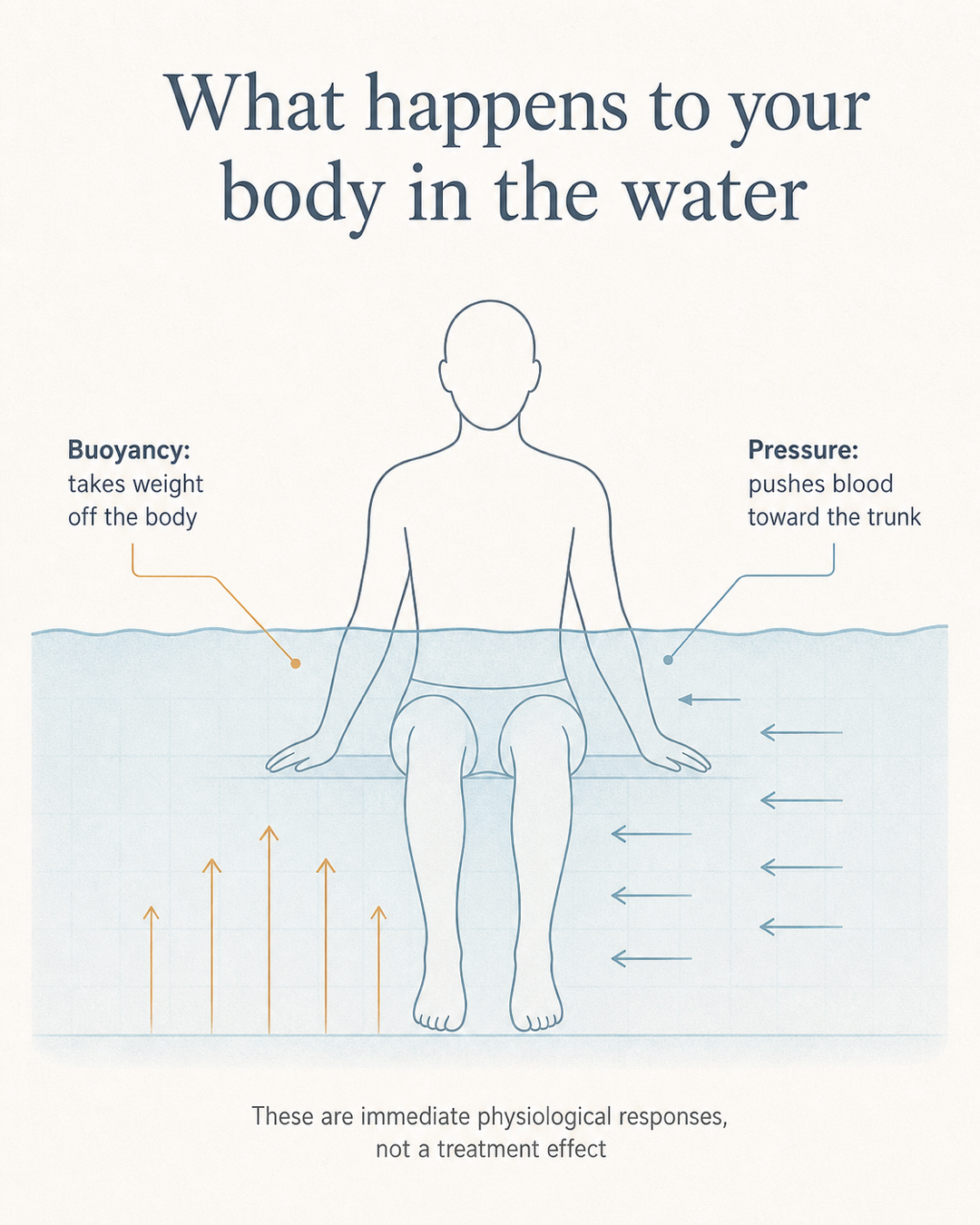
This is the layer most often overlooked, yet it best explains why "a soak just feels different." When your whole body (or half of it) is in the water, it meets two forces:
- Buoyancy: it takes weight off the body, so the joints and muscles need to work less to hold you up.
- Hydrostatic pressure: the water presses inward on the body from all sides, pushing blood and body fluid from the limbs toward the central trunk. The physiology literature (a commentary on immersion hydrostatic pressure, 2022; Epstein et al.'s classic head-out immersion study, 1976) notes that this increases venous return and raises cardiac output, and triggers responses such as diuresis and heart-rate regulation.
This explains why "being in the water" sends a different signal to the body than "standing in a shower" or "just being somewhere very hot" — immersion alone is a distinct set of immediate physiological responses. This is where a hot spring / a bath genuinely beats a shower, and it has nothing to do with minerals. Hold the boundary: these are immediate, acute physiological responses, not a proven long-term treatment effect. It solidly explains "it feels different," but it does not prove "soaking can treat anything."
4. Why "whether mineral springs are actually better" is so hard to study
This is the layer people most want to know about — and also where the evidence most needs to be read conservatively. The research limitations below are stated once, here, and not repeated later. "Balneotherapy" has, across multiple systematic reviews, shown positive results for certain conditions — for example osteoarthritis (2023), fibromyalgia (2024), non-specific low back pain (2025), some skin conditions (2024), and, more recently, post-COVID (2025). This is population-level, reference-worthy evidence. But a scoping review specifically examining whether clinical balneotherapy studies can be blinded (2025) points to a structural problem: among the clinical balneotherapy trials it examined, only about 11% attempted a double-blind design. Note what this number means — it says "it is very hard, in practice, to keep participants and assessors unaware of whether they are soaking in a mineral spring," not that the rest of the studies are all invalid — but the overall quality of the evidence is therefore lower, and strong conclusions are hard to draw. The reason is very practical: a mineral spring has smell, texture and the feeling of floating, so participants almost certainly know whether they're soaking in a spring or in tap water. So cleanly separating "the effect of the minerals themselves" from "heat + being in the water + resting in a relaxing environment + expectation about the spring" is methodologically very difficult. Here is a key turn: these things — smell, texture, environment, expectation — are confounders that research has to exclude, but in real life they are precisely part of the experience. That research can't separate them out doesn't mean they don't exist for you. So the scientifically honest statement is: it cannot be proven that "a mineral spring is necessarily clinically superior to ordinary hot water" — and that statement is a different thing from "the two experiences are exactly the same."
| On balneotherapy | What science can currently say | What science currently cannot say |
|---|---|---|
| Effect on certain conditions | Some systematic reviews observe positive results (pain, function and other markers) | These disease outcomes are not a promise to every reader |
| The role of minerals | There is theory and some research exploring it | It cannot be clinically proven that "the minerals themselves" can be quantified separately from heat / rest / expectation |
| Hot spring vs. hot bath | The two experiences are genuinely different physiologically and sensorially | It cannot be proven that "a mineral spring is generally clinically superior to ordinary hot water" |
| Research quality | A fair number of reviews exist | Blinding is hard, quality is on the lower side; strong conclusions should stay conservative |
5. So how do people in different regions describe soaking?
That it can't be cleanly separated in the clinic doesn't mean the "difference in experience" doesn't exist. Move the lens from the lab to real users, and verifiable surveys and studies from several countries point, fairly consistently, to "soaking as a whole experience."
- Japan (national surveys and peer-reviewed research): A peer-reviewed study based on a Japanese nationwide online survey (Takeda et al., Heliyon, 2023) found that hot-spring bathing habits correlated positively with several measures of subjective mental-health satisfaction; the authors themselves note that part of the benefit may come from leaving the home, contact with nature, and relaxing in a natural setting — not the water alone. In Japan's Ministry of the Environment national survey on "hot-spring bathing effects" (as compiled by RIETI), the hot-spring users surveyed reported fatigue relief 83.0%, improved sense of well-being 82.6%, stress relief 82.0%, and better sleep 81.1% — a self-reported survey covering hot-spring users only (the source itself notes this limitation), usable as a clue about "perception," not as causal proof. There is also a Japanese study comparing "ordinary hot water" and "hot-spring water" at the same facility (Watanabe et al., 2009, older, labeled foundational), which observed a greater relaxation effect for the hot-spring water.
- Europe (health systems and patient-reported outcomes): An analysis comparing balneotherapy in Spain, France, Italy and Portugal (Int J Biometeorology, 2023, covering 22 documents from 2000–2022) shows that balneotherapy is, in several European countries, a practice that is institutionally accepted and embedded in a public-health context; and an observational patient-reported-outcomes study at the Saturnia thermal springs in Italy (97 patients, assessed with VAS and SF-36) observed that when treatment courses were interrupted by the pandemic, patients' self-reported outcome markers worsened. These are observations at the population / situational level, not mineral-specific causation.
- Chinese-speaking region (wellness tourism and place research): A wellness-tourism study in Shizhu, China (Int J Contemporary Hospitality Management, 2022, SEM, 1,472 wellness travelers) found a positive association between restorative experience and perceived health and place attachment. This kind of data speaks to the subjective restorative experience within a journey and a setting, not the clinical efficacy of mineral springs; what it adds is an explanation of why people come to understand a soak as a whole experience of leaving the everyday and entering a particular environment.
Put together, it can be said neutrally: across research from Japan and Europe to the Chinese-speaking region, people often place the value of a soak in relaxation, a natural setting and leaving the everyday — not just in heating up water. These are mostly self-reported, correlational or institutional-context data; they can't be upgraded into clinical efficacy, nor do they represent how every person on earth feels — but they also shouldn't be dismissed lightly as "just psychological." The senses, environment, expectation and ritual are part of the complete soaking experience to begin with.
6. So, "does it really feel the same"?
Put all six things together, and the honest answer can hold two statements at once:
- The difference science can isolate: the immediate physiological responses caused by heat and by being in the water (buoyancy, hydrostatic pressure) — a hot spring / a bath is genuinely different from a shower.
- The part science still can't cleanly isolate: the isolated clinical contribution of the minerals is currently hard to quantify separately from heat, rest, environment and expectation.
- What people actually feel: a soak also includes smell, texture, a natural setting, cultural memory and the ritual of "I am taking good care of myself" — it isn't fake, and it can't be equated directly with treatment.
So it can honestly be said: a hot spring and a hot bath are not the same experience; and at the same time it makes no claim to treat anything. Rather than agonizing over "which is more effective," it's better to treat it as something you enjoy, and do safely.
7. More important than efficacy: safety (temperature, time, populations)
Hot baths and soaking have clear safety lines, and this is actually where the evidence is relatively clear.
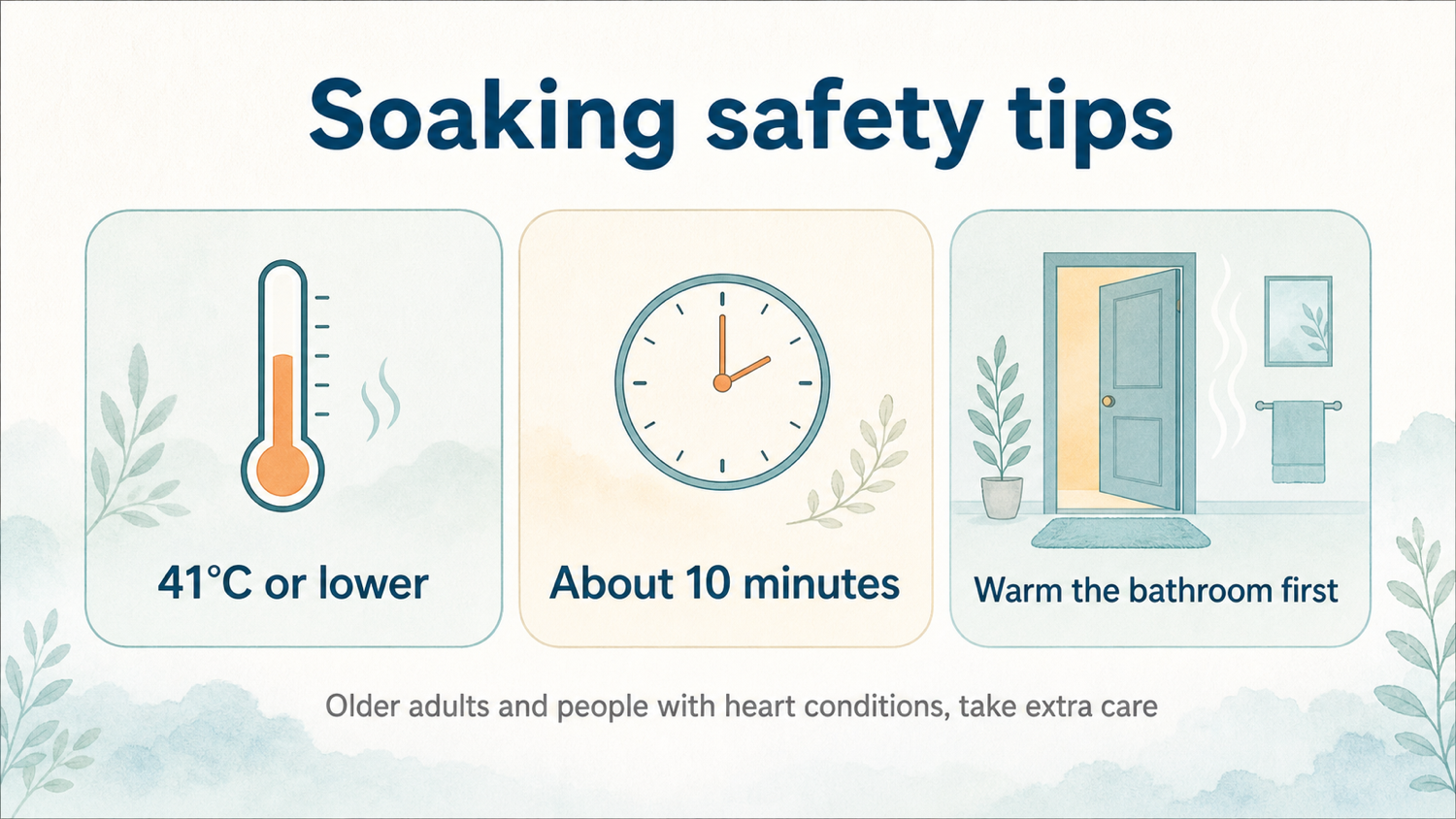
- Water temperature and time: Japan's Consumer Affairs Agency advises, for winter bathing, a water temperature of 41°C or lower and soaking for about 10 minutes, warming the changing room and bathroom first and rising slowly afterward.
- "Heat shock" risk: an abrupt temperature difference can swing blood pressure sharply and may trigger fainting or a cardiovascular event (see the medical review on heat-exposure-related illness, 2026; the study comparing adverse events in soaking vs. general bathing, 2025).
- Higher-risk populations: Japanese official data has long warned that the risk of bathtub-drowning accidents is especially notable for people aged 65 and over; the Consumer Affairs Agency also emphasizes reducing temperature gaps, controlling water temperature and time, and avoiding rising suddenly. Older adults and people with cardiovascular disease should be more careful, avoid overheating and staying in too long, and ideally have someone nearby.
- These are general safety reminders, not a personal medical diagnosis.
8. How to understand it (actionable)
- If you're after relaxation, enjoy a soak freely — but don't treat it as a medical measure with guaranteed efficacy.
- Start with the safe range of 41°C or lower, about 10 minutes; get out if you feel stuffy, palpitations or dizzy.
- In winter, warm the bathroom and changing room first to reduce the temperature gap; rise slowly.
- Older adults and people with cardiovascular or chronic conditions should take extra care before soaking and ideally have company.
- If you want to keep something closer to a hot spring's smell, mineral feel and ritual at home, you can upgrade a hot bath into a soak with a hot-spring feel — the point is the experience and safety.
Medical boundary
This article is general health and lifestyle information, not a medical diagnosis or treatment advice. If you have cardiovascular disease, are pregnant, have an unstable skin condition, a chronic illness or any medication, please consult a medical professional before soaking; if you feel unwell while soaking, get out immediately and seek help.
FAQ
(each answer carries a distinct value; the same caveat is not repeated) Q1: Do a hot spring and a hot bath produce the same bodily response? No. Beyond heat, being in the water brings buoyancy and hydrostatic pressure, which give the body a different immediate physiological response than a shower (increased venous return, diuresis, and so on). This layer of difference has nothing to do with minerals; it's caused by "being in the water" itself.
Q2: Are the minerals in a hot spring really the key? This is the hardest question for current research. A mineral spring has smell and texture and is almost impossible to blind (a 2025 scoping review found only about 11% of relevant clinical trials attempted double-blinding), so the effect of "the minerals themselves" is very hard to quantify separately from heat, rest and expectation. It can be said that it cannot yet be clinically proven that the minerals are the main contributor — but that is "hard to prove," not "proven to make no difference."
Q3: Then why do so many people feel a hot spring is more relaxing? Research from Japan and Europe to the Chinese-speaking region shows people often place a soak's value in relaxation, closeness to nature and leaving the everyday. These data are mostly self-reported, correlational or institutional-context; they can't represent every person on earth and don't equal clinical efficacy — but they do show that environment and ritual are part of the soaking experience to begin with.
Q4: Does a single hot spring or hot bath deliver health benefits? The marker changes in research (vascular and so on) mostly come from repeated interventions over "weeks, several times a week," and are marker changes in specific populations — you can't extrapolate them to a single soak. The value of a single soak sits better under "relaxation and experience" than under "efficacy."
Q5: How hot and how long is safe to soak? The general safety advice is a water temperature of 41°C or lower and about 10 minutes (Japan's Consumer Affairs Agency); in winter, warm the bathroom first, reduce the temperature gap, and rise slowly. Older adults and people with cardiovascular conditions should be especially careful.
Q6: Who needs to be especially careful? Older adults and people with cardiovascular disease, pregnancy, or skin or chronic conditions are higher-risk groups; it's advisable to consult a medical professional before soaking, avoid overheating and staying in too long, and ideally have someone nearby.
If what you care about was never just 'making the water hot,' but the distinctive smell, mineral feel and slow ritual of Beitou white sulphur, DaFang White-Sulphur Hot-Spring Powder offers a way to bring the atmosphere of a Beitou white-sulphur spring back into everyday life; the point is experience and safety, not efficacy. For how to use it, see How to use white-sulphur hot-spring powder.
Extended reading
- How to use white-sulphur hot-spring powder: the correct method and cold-soak tips
- How warm is a 41°C footbath? Water temperature, time and the right way to soak feet before bed
- Tanghua and sulphur powder are two different things: raw sulphur powder, sulphur springs, white-sulphur hot-spring powder
Core mechanism / clinical
C01Balneotherapy for osteoarthritis: SR — Rheumatology International, 2023. https://pmc.ncbi.nlm.nih.gov/articles/PMC10348981/C02Balneotherapy in fibromyalgia: SR & meta — Int J Biometeorol, 2024 (abstract-only). https://link.springer.com/article/10.1007/s00484-024-02732-3C03Balneotherapy for back pain: SR — Wien Med Wochenschr, 2025 (abstract-only). https://link.springer.com/article/10.1007/s10354-025-01118-3C04Balneotherapy & dermatological diseases: SR — Int J Biometeorol, 2024 (abstract-only). https://link.springer.com/article/10.1007/s00484-024-02649-xC05Challenges of blinding in clinical balneology trials: scoping review — BMC Complement Med Ther, 2025 (about 11% attempted double-blind; core limitation). https://link.springer.com/article/10.1186/s12906-025-04878-yC06Balneotherapy in post-COVID-19: SR — Healthcare (MDPI), 2025. https://www.mdpi.com/2227-9032/13/2/96A01Heat therapy: mechanistic underpinnings & cardiovascular health — review, 2021. https://pmc.ncbi.nlm.nih.gov/articles/PMC8285605/A02Hot-water immersion & cardiovascular/cardiorespiratory health: SR & meta — Physiological Reports, 2026. https://physoc.onlinelibrary.wiley.com/doi/10.14814/phy2.70668A03Non-acute passive heating on cardiometabolic risk & vascular health: SR & meta of RCTs — 2025. https://pmc.ncbi.nlm.nih.gov/articles/PMC12490526/A04Brunt et al. Passive heat therapy improves endothelial function… — J Physiol, 2016 (RCT, foundational). https://pmc.ncbi.nlm.nih.gov/articles/PMC5023696/B01Commentary: circulatory effects of increased hydrostatic pressure (immersion/submersion), 2022. https://pmc.ncbi.nlm.nih.gov/articles/PMC8829458/B02Epstein. Cardiovascular & renal effects of head-out water immersion — Circ Res, 1976 (foundational). https://www.ahajournals.org/doi/pdf/10.1161/01.res.39.5.619D01Acute Heat Exposure-Related Illness (hot baths/springs/saunas): narrative review — J Clin Med, 2026. https://www.mdpi.com/2077-0383/15/5/1910D02Bathing-related adverse events, hot spring vs general bathing: retrospective — 2025. https://pmc.ncbi.nlm.nih.gov/articles/PMC12185896/D03a(official guidance) Japan Consumer Affairs Agency, winter bathing accident prevention: 41°C or lower, about 10 min, warm the bathroom to reduce temperature gap. https://www.caa.go.jp/policies/policy/consumer_safety/child/project_001/mail/20231211/D03b(official statistics) Japan MHLW Vital Statistics / Consumer Affairs Agency reminder on older-adult bathtub drowning. the source figure could not be confirmed precisely, so this article does not cite that number. https://www.caa.go.jp/policies/policy/consumer_safety/child/project_001/mail/20231211/- (note: the
17,000/yearestimate is omitted because a readable primary source could not be confirmed.)
Added: subjective experience / user surveys / cultural setting (lived-experience layer)
E01Takeda M. et al. "Hot spring bathing practices have a positive effect on mental health in Japan" — Heliyon 9(9), 2023 | Japan nationwide online survey | PubMed 37809617 / PMC10558852. https://pubmed.ncbi.nlm.nih.gov/37809617/. This article cites it because it shows a correlation between hot-spring habits and subjective mental-health satisfaction; it is cross-sectional, self-reported, correlational data, not causal proof.E02(official survey) Japan Ministry of the Environment "hot-spring bathing effects" national survey (as compiled by RIETI, Sekiguchi 2020/2021; Hayasaka briefing): hot-spring users reported fatigue relief 83.0%, well-being 82.6%, stress relief 82.0%, improved sleep 81.1%. https://www.rieti.go.jp/en/columns/s21_0006.html | use: user "perception" clue | boundary: self-report, hot-spring users only, uncontrolled, not causal.E03Watanabe M. et al. "Effects of hot spring bathing on stress reduction, compared with plain water bathing" — J Japanese Society of Biometeorology 46(1):27–34, 2009 (foundational). https://doi.org/10.11227/seikisho.46.27 | use: same-facility "hot-spring water vs. plain hot water," greater relaxation effect | boundary: older, small sample, relaxation marker.E04"Comparative analysis of balneotherapy in European public health systems: Spain, France, Italy, Portugal" — Int J Biometeorol, 2023 (22 documents 2000–2022) | PubMed 36869881. https://pubmed.ncbi.nlm.nih.gov/36869881/. This article cites it because it shows how balneotherapy is institutionally positioned in several European countries; it is a health-systems analysis, not efficacy proof.E05"COVID-19-Related Discontinuation Impact on Patient-Reported Outcomes in Long-Term Thermal Therapy: Saturnia Thermal Springs" — observational study, Italy, 97 patients, VAS/SF-36 | PMC11764649. https://www.ncbi.nlm.nih.gov/pmc/articles/PMC11764649/. This article cites it because it records worse patient-reported outcomes after treatment interruption; it is observational and limited to a specific situation and condition.E06"Recovery experience of wellness tourism and place attachment" — Int J Contemporary Hospitality Management 34(8):2934–2952, 2022 | SEM, Shizhu China, 1,472 wellness travelers (N2020=494, N2021=978). https://www.emerald.com/ijchm/article-abstract/34/8/2934/. This article cites it because it discusses the link between recovery experience, perceived health, and place attachment; it relies mainly on SEM self-report measures.E07"Development and Initial Validation of Healing and Therapeutic Design Indices… Hot Spring Tourism" — Buildings (MDPI), 2025 | doi 10.3390/buildings15162837. https://doi.org/10.3390/buildings15162837. The 31.7% / 26.3% / 22.6% percentages could not be confirmed precisely in the source, so this article does not cite them.