
The short version
- Summer dryness, itching, and stinging usually don't come from a single cause. They're the result of your baseline skin condition combined with heat, sweat, low-humidity air-conditioning, friction, sun exposure, and how you cleanse — all acting at once. Reducing it to "you shower too much" or "you skipped one product" misses the picture.
- On whether summer actually makes skin drier or more hydrated: in a 2022 systematic review in Skin Health & Disease, "Transepidermal water loss (TEWL): Environment and pollution — A systematic review," Green, Kashetsky, Feschuk and Maibach found that studies on how season and climate affect transepidermal water loss (TEWL) are inconsistent and inconclusive, while pollutant exposure is associated with higher TEWL (TEWL varies by site, age and measurement method, and is a reference indicator, not a diagnosis).
- Sweat has two sides: in a 2018 review in Allergology International, "Sweat in the pathogenesis of atopic dermatitis," Murota, Yamaga, Ono and Katayama note that sweat takes part in temperature regulation and in the skin's hydration and defense, but sweat that lingers, along with its components, can also irritate skin and trigger itching. Blocked sweat ducts can form heat rash; some people break out in tiny, prickly, itchy wheals whenever they sweat or their body temperature rises, which may be cholinergic urticaria. If this comes with difficulty breathing, wheezing, dizziness, or swelling of the lips, tongue, or throat, then per Mayo Clinic Staff's 2025 "Anaphylaxis: Symptoms & causes" and StatPearls' 2023 "Anaphylaxis" (Kevin McLendon, Britni T. Sternard) these are severe-allergy emergency warning signs — seek emergency care immediately or call your local emergency number.
- Moisturizing is the foundation: in the American Academy of Dermatology's 2026 "Dermatologists' top tips for relieving dry skin" (Paula Ludmann), the advice is to apply while the skin is still slightly damp after washing, and that creams or ointments usually lock in moisture better than lotions (general care information, not disease treatment). Cleansing is only one kind of exposure — gentle and fragrance-free is enough, and you don't need to apply cleanser to every part of your body.
- If self-care doesn't help or symptoms keep coming back, or if you develop blisters, broken skin or wounds, itching that disrupts sleep, widespread peeling, marked local heat and pain or an accompanying fever, or a possible infection, seek professional evaluation such as from a dermatologist (following the care-and-when-to-see-a-doctor guidance in the American Academy of Dermatology's 2021 "Managing eczema in summertime" and Paula Ludmann's 2026 "Dermatologists' top tips for relieving dry skin"). This article is a knowledge summary, not a diagnosis, and can't replace seeing a doctor.
1. First, understand the skin barrier: the foundation of summer problems
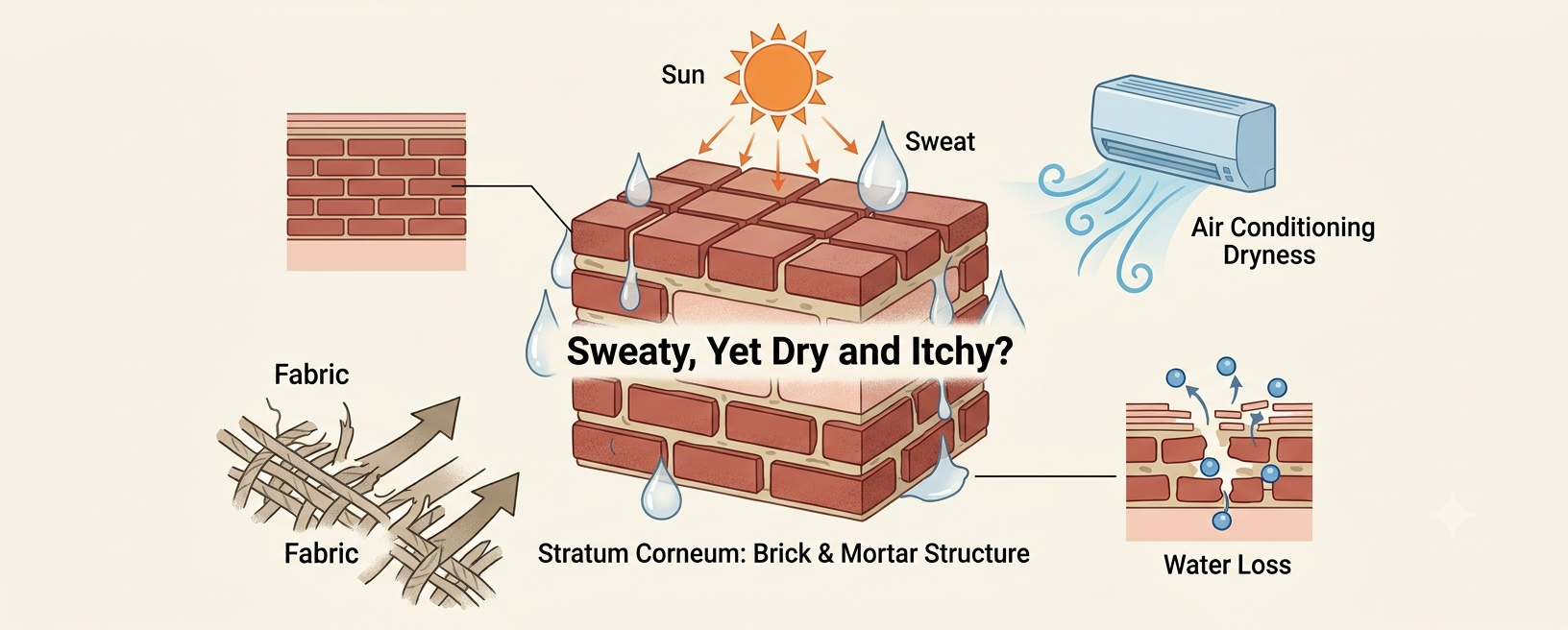
To understand why skin turns dry, itchy, and stinging in summer, start with the stratum corneum, the skin's outermost layer. It works like a brick wall, built from corneocytes (the bricks) and intercellular lipids (the mortar), and it's the skin's main moisture barrier: keeping water in and keeping outside irritants out.
One common indicator of how "leaky" this barrier is is transepidermal water loss (TEWL) — the amount of water lost through the skin. According to Green, Kashetsky, Feschuk and Maibach's 2022 systematic review in Skin Health & Disease, "Transepidermal water loss (TEWL): Environment and pollution — A systematic review," TEWL varies by measurement site, age and method and is a reference indicator rather than a standalone diagnosis; that review also found that studies on how season and climate affect TEWL are inconsistent and inconclusive, while pollutant exposure is associated with higher TEWL. So neither "summer is humid, so skin won't get dry" nor "sweating and sun exposure must cause more water loss" can be stated flatly — summer isn't necessarily drier or more hydrated.
In other words, the state of your skin in summer isn't decided by "season" alone. It's shaped together by your environment and habits (air-conditioning, sweat, friction, cleansing).
Takeaway: how good your barrier is determines how well you tolerate the various summer irritants.
2. How the summer environment leaves skin "both damp and dry"
Summer's most contradictory sensation is this: outside it's humid and hot with nonstop sweat, while indoors it's dry enough to leave skin tight, itchy, and stinging. Air-conditioning is one common reason.
Spending long stretches in a dry, air-conditioned room means being in a low-humidity environment, which may make the stratum corneum lose water more easily, bringing tightness, flaking, and irritation. In the American Academy of Dermatology's 2026 "Dermatologists' top tips for relieving dry skin," Paula Ludmann explains that low humidity makes skin drier and that, in dry conditions, a humidifier can help (general care advice, not something everyone needs). But a caveat: the low humidity created by air-conditioning is only "one possible factor," not the main cause for everyone — each person's skin and surroundings are different.
About humidifying: indoors during a Taiwanese summer is actually often on the damp side. The U.S. Environmental Protection Agency's 2025 "Mold Course, Chapter 9" notes that excessive indoor relative humidity (above roughly 60%) tends to condense and encourage mold, and that humidifying equipment, if not cleaned, can disperse mold or bacteria into the air (this is building-humidity and mold-management guidance, not an individual skin prescription). So rather than switching on a humidifier across the board, the more practical approach is to first check whether the room is genuinely dry: if it's already damp, you don't need extra humidification; adjust moderately only when it really is dry, and whether you humidify or dehumidify, clean the equipment regularly.
After high outdoor heat and heavy sweating, sweat gradually evaporates once you step into an air-conditioned room; if the room is also on the dry side, then together with sun exposure and clothing friction, skin may feel tight or uncomfortable more easily.
Takeaway: for dry summer skin, low-humidity air-conditioning may be one cause, but it isn't everyone's main one; look at your own environment first, then decide whether to adjust the humidity.
3. Sweat — ally or irritant?
Sweat is often blamed as the culprit behind skin problems, but the reality is more nuanced. In their 2018 review in Allergology International, "Sweat in the pathogenesis of atopic dermatitis," Murota, Yamaga, Ono and Katayama note that sweat handles temperature regulation and is also related to the skin's hydration and defense; yet sweat that lingers on the skin, along with its components, can also irritate the skin and trigger itching. The point isn't "whether you sweat," but "whether the sweat lingers and gets trapped."
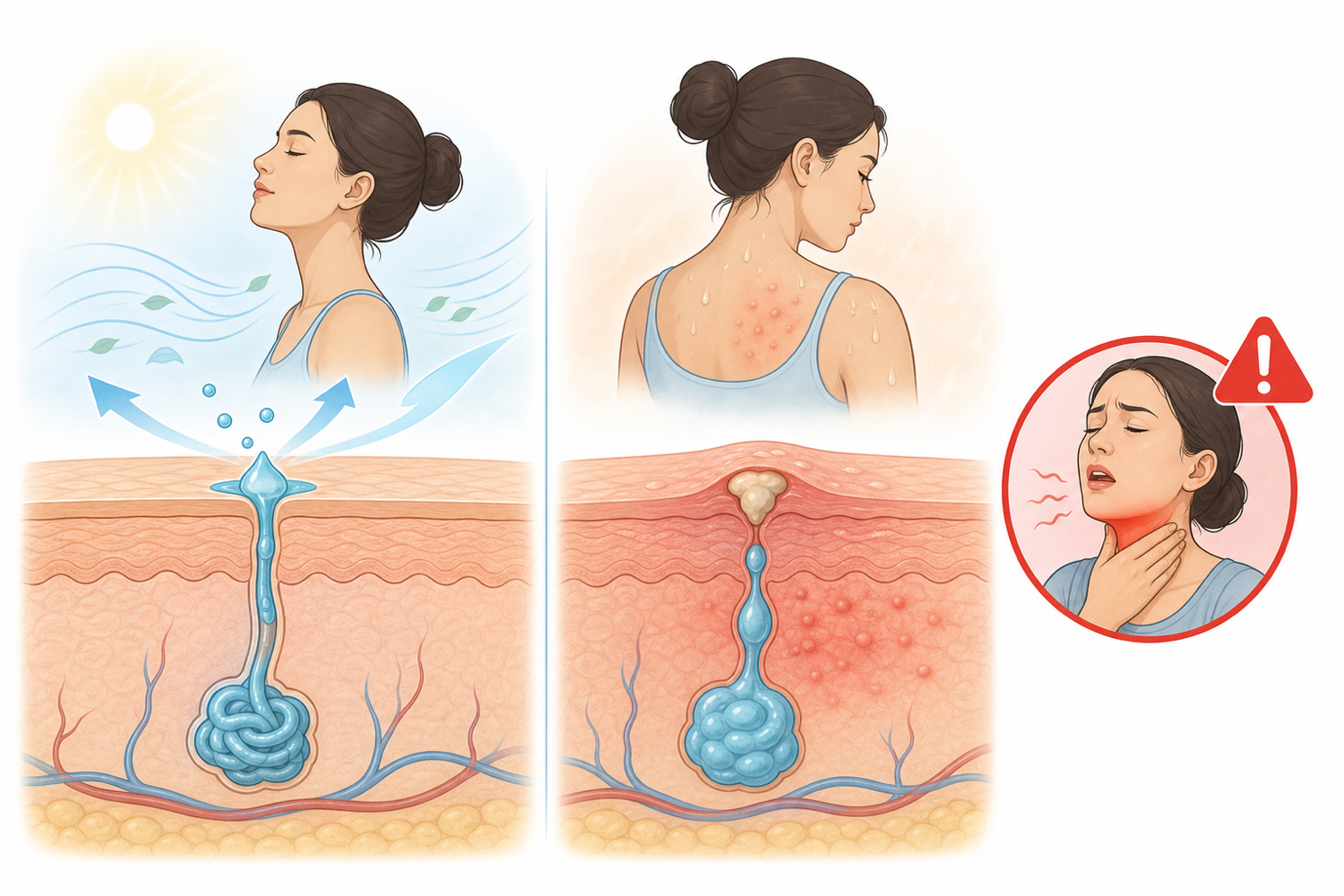
Blocked sweat ducts and heat rash (miliaria)
When sweat ducts are blocked and sweat is retained in the skin, heat rash (commonly called miliaria or prickly heat) can form, bringing a prickly, itchy feeling. According to Guerra, Toncar and Krishnamurthy's 2024 StatPearls entry "Miliaria," and the New Zealand dermatology education resource DermNet's 2023 "Miliaria," general prevention leans toward cooling down, wearing breathable clothing, and avoiding prolonged heat and friction. Whether it's actually heat rash, and which type, still needs professional judgment; this article can't diagnose it for you.
Itchy and stinging the moment you sweat? Cholinergic urticaria may need evaluation
Some people develop tiny, itchy, or stinging wheals when they sweat, exercise, take a hot shower, feel stressed, or their body temperature rises. As Fukunaga et al.'s 2023 review in the American Journal of Clinical Dermatology, "Cholinergic Urticaria: Subtype Classification and Clinical Approach," and DermNet's 2022 "Cholinergic urticaria" explain, this temperature-related reaction may need evaluation for cholinergic urticaria.
Take special note: both Mayo Clinic Staff's 2025 "Anaphylaxis: Symptoms & causes" and StatPearls' 2023 "Anaphylaxis" (Kevin McLendon, Britni T. Sternard) warn that if such reactions come with difficulty breathing, wheezing, marked dizziness, or swelling of the lips, tongue, or throat, it may be a sign of a severe allergic reaction (anaphylaxis); in that case, don't wait and watch — seek emergency care immediately or call your local emergency number.
Also, not all "sweat-related itching and stinging" is urticaria — it could be heat rash, dryness, or a sensitive reaction, which are handled differently and should be distinguished by a professional rather than self-diagnosed.
Takeaway: sweat is double-edged. Don't let it linger, and don't trap the skin; when regular, temperature-related itchy wheals appear, it's worth a professional evaluation; and the moment the severe-allergy warning signs above appear, seek emergency care immediately.
4. Why are some people especially prone to dryness, itching, and stinging?
Same summer: some people are only mildly dry, while others itch so much they can't sleep. The difference often lies in each person's barrier status and skin type.
How dryness, itching, and inflammation influence one another
According to Gade, Matin and Rubenstein's 2023 StatPearls entry "Xeroderma," dry skin is related to insufficient natural moisturizing factors and lipids and to increased TEWL; dryness itself can cause itching, and over the long term, barrier damage and repeated scratching can also make skin more prone to inflammation. A caveat: dryness, itching, and inflammation may influence one another, but not everyone follows a fixed sequence — don't think of it as a road that will inevitably run to the end.
Sensitive skin isn't the same as atopic dermatitis
These two are often conflated, but they aren't the same:
- "Sensitive skin" is closer to a commonly used description of a skin state; it isn't the same as a single disease name.
- "Atopic dermatitis" is a chronic skin disease that needs to be diagnosed and managed by medical professionals, often marked by recurring flares, eczema in specific areas, and a family history of allergy.
In other words, sensitive skin is a state many people may have, while atopic dermatitis is a problem at the level of disease. If you suspect the latter, it should be evaluated by a dermatologist rather than self-diagnosed.
As for why people with a weaker barrier are especially prone to itching, Kamata, Tominaga and Takamori's 2025 review in the Juntendo Medical Journal, "Mechanisms of Itch in Atopic Dermatitis," proposes possible mechanisms including immune and neural signals that make skin more sensitive, plus the "the more you scratch, the more it itches; the more it itches, the more you scratch" cycle that makes the problem worse. For people who break out in rashes easily and itch easily, the aforementioned Murota et al. 2018 Allergology International "Sweat in the pathogenesis of atopic dermatitis" also notes that sweat can worsen discomfort; and the American Academy of Dermatology's 2021 "Managing eczema in summertime" suggests that rinsing off sweat after exercise is a reasonable care practice.
Takeaway: whether you're especially prone to dryness, itching, and stinging largely depends on your baseline barrier and skin type; first tell "sensitive skin" and "atopic dermatitis" apart, so you know whether the next step is self-care or seeing a doctor.
5. Cleansing and moisturizing: putting "showering" back in its proper place
It's easy to blame all summer dryness and itching on "showering." But from an everyday skin-care standpoint, cleansing is only one of the factors that may affect skin — alongside heat, sweat, air-conditioning, friction, and sun exposure, not the sole answer.
Cleansing: gentle is enough, and you don't need to apply cleanser everywhere
As the aforementioned Gade, Matin and Rubenstein 2023 StatPearls "Xeroderma," and DermNet's 2022 "Dry skin (xeroderma)" both note, strongly alkaline soaps or irritating surfactants can make dryness, itching, and tightness more noticeable (a general tendency; individual situations still vary). A more reasonable approach is gentle, fragrance-free cleansing, and you don't need to use cleanser on every part of your body — oilier areas and easily dry areas can be handled separately.
Moisturizing: timing and formulation matter more than brand
Moisturizing is the foundation of caring for dryness and itching. In the American Academy of Dermatology's 2026 "Dermatologists' top tips for relieving dry skin," Paula Ludmann recommends applying after washing while the skin is still slightly damp, and notes that for locking in moisture, creams or ointments are usually better than lotions. This is general care information, not a disease-treatment claim.
Takeaway: keep cleansing gentle and not excessive; moisturize while damp and choose the right formulation; put showering back in its place as "one kind of exposure," and you won't be captured by any single claim.
6. A low-risk daily care checklist for summer
The following practices are drawn from the American Academy of Dermatology's 2021 "Managing eczema in summertime" and the same academy's 2026 "Dermatologists' top tips for relieving dry skin" (Paula Ludmann), as well as Guerra, Toncar and Krishnamurthy's 2024 StatPearls "Miliaria." They are general, low-risk principles suitable as a reference for most people (if you have a specific condition or take medication, follow your doctor's instructions):
- Take short, warm (not hot) showers; avoid soaking in very hot water for long periods.
- Use fragrance-free cleansing and moisturizing products to reduce unnecessary irritation.
- Rinse off as soon as possible after sweating, pat dry gently with a towel (avoid rubbing back and forth), change into dry clothes, and don't let sweat linger and trap heat.
- Wear loose, breathable cotton clothing to reduce friction and stuffiness.
- Manage temperature and humidity according to the actual indoor humidity, adjusting humidification or dehumidification only when needed, and clean the equipment regularly.
- Practice good sun protection to reduce the extra burden of sun exposure on the skin.
- Moisturize while the skin is still slightly damp after washing; for dry areas, choose creams or ointments.
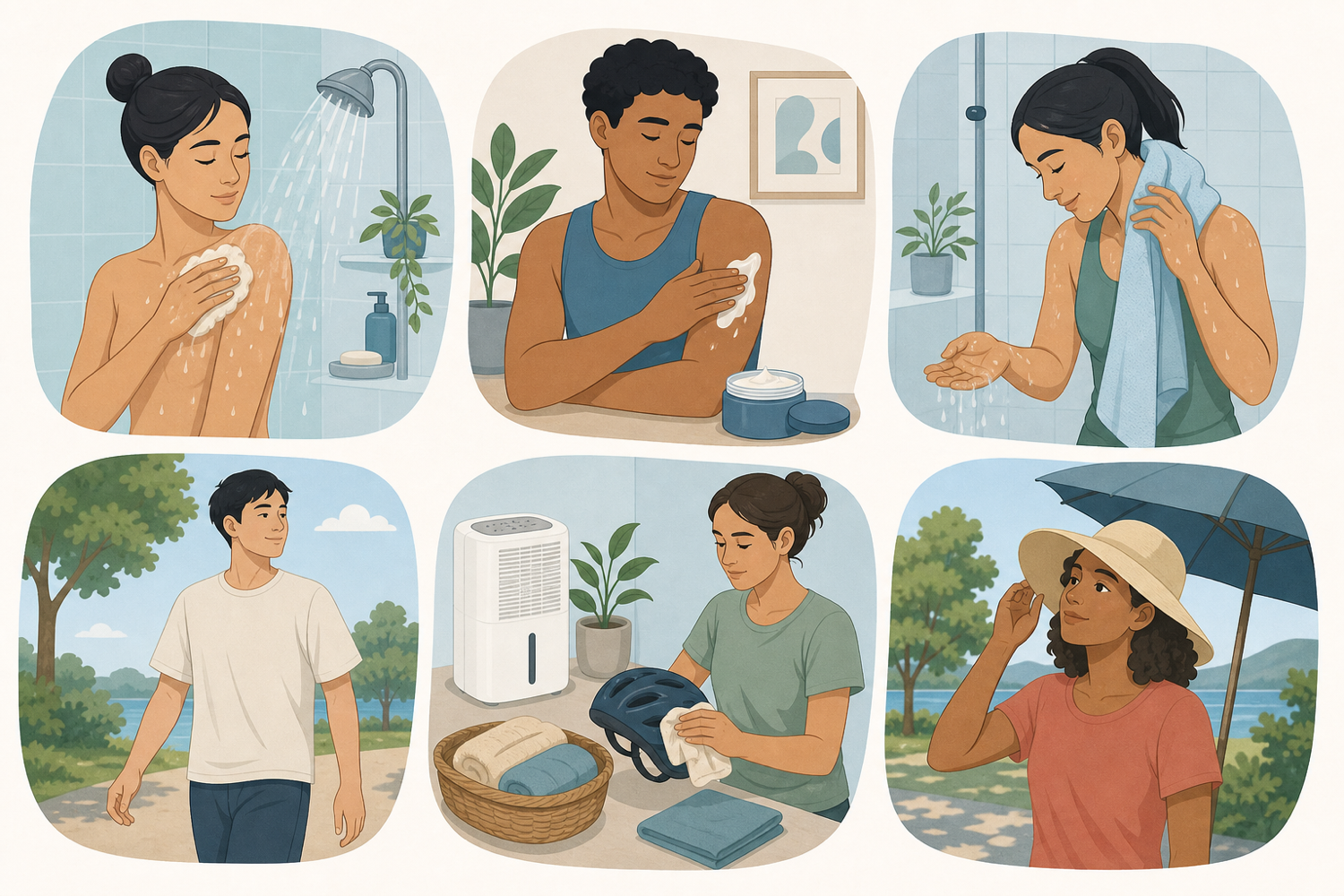
Reminder: this is a general checklist, not personalized medical advice.
7. When should you see a doctor? When to seek care, emergency warning signs, and the general management of atopic dermatitis
Self-care has its limits. Following the care-and-when-to-see-a-doctor guidance in the American Academy of Dermatology's 2021 "Managing eczema in summertime" and Paula Ludmann's 2026 "Dermatologists' top tips for relieving dry skin," seek professional evaluation, such as from a dermatologist, if:
- After self-care (moisturizing, avoiding irritants), things still don't improve, or they keep recurring.
- Blisters, broken skin, or wounds appear, or there's widespread peeling.
- Itching disrupts sleep or daily life.
- There's marked local heat and pain, or an accompanying fever, or a possible infection (oozing, pus, and the like).
Also remember: both Mayo Clinic Staff's 2025 "Anaphylaxis: Symptoms & causes" and StatPearls' 2023 "Anaphylaxis" (Kevin McLendon, Britni T. Sternard) warn that if itching and wheals come together with difficulty breathing, wheezing, marked dizziness, or swelling of the lips, tongue, or throat, these are emergency warning signs of a severe allergic reaction — seek emergency care immediately or call your local emergency number, and don't wait and watch.
As for the general management of atopic dermatitis, the American Academy of Dermatology's 2021 "Managing eczema in summertime" typically emphasizes: moisturizing regularly, identifying and avoiding triggers, receiving patient education, and letting clinicians decide whether further treatment is needed. This article doesn't provide prescription instructions, and it doesn't advise stopping medication on your own or delaying care.
Takeaway: knowing "when to stop toughing it out alone" is as important as knowing "how to care for your skin"; remember these warning signs, and see a doctor when you should.
Frequently asked questions (FAQ)
Q1: Why does summer skin feel dry, itchy, and stinging even though it's humid and I'm sweating?
What decides the state of your skin is often not "season," but your environment and habits: low humidity from dry air-conditioning, sweat retention and evaporation, clothing friction, sun exposure, and how you cleanse — all acting at once. Per Green, Kashetsky, Feschuk and Maibach's 2022 Skin Health & Disease systematic review, "Transepidermal water loss (TEWL): Environment and pollution — A systematic review," there's no firm conclusion on how season and climate affect skin water loss, so it's hard to declare in one sentence that summer is definitely drier or more hydrated.
Q2: Itchy and stinging the moment I sweat — is it an allergy?
Not necessarily. It could be irritation from sweat retention, heat rash from blocked sweat ducts (Guerra, Toncar and Krishnamurthy's 2024 StatPearls "Miliaria"), cholinergic urticaria related to a rising body temperature (Fukunaga et al.'s 2023 American Journal of Clinical Dermatology "Cholinergic Urticaria: Subtype Classification and Clinical Approach"), or simply dryness or a sensitive reaction. But if it comes with difficulty breathing, wheezing, dizziness, or swelling of the lips, tongue, or throat, then per Mayo Clinic Staff's 2025 "Anaphylaxis: Symptoms & causes" and StatPearls' 2023 "Anaphylaxis" (Kevin McLendon, Britni T. Sternard) these are emergency warning signs — seek care immediately; for other situations, if it recurs or bothers you, have a professional distinguish it.
Q3: Why does an air-conditioned room make skin drier, and what should I do?
The American Academy of Dermatology's 2026 "Dermatologists' top tips for relieving dry skin" (Paula Ludmann) notes that spending a long time in a low-humidity environment makes skin drier, with tightness and irritation; but this is only one possible factor, not everyone's main cause. The approach is to first check whether the room is genuinely dry, adjust the humidity moderately only when needed, and clean the equipment regularly (the U.S. EPA's 2025 "Mold Course, Chapter 9" warns that excessive humidity condenses and encourages mold and that equipment needs cleaning), and to moisturize while the skin is still slightly damp after washing.
Q4: With summer dryness and itching, when should I see a doctor?
Per the American Academy of Dermatology's 2021 "Managing eczema in summertime" and Paula Ludmann's 2026 "Dermatologists' top tips for relieving dry skin," when things still don't improve after self-care or keep recurring, or when blisters, broken skin or wounds, widespread peeling, sleep-disrupting itching, marked local heat and pain or an accompanying fever, or a possible infection appear, seek professional evaluation; and if severe-allergy warning signs appear, seek emergency care immediately.
Q5: When should I moisturize, and what's better to use?
The American Academy of Dermatology's 2026 "Dermatologists' top tips for relieving dry skin" (Paula Ludmann) recommends the principle of "apply while damp": moisturizing works better when the skin still has some moisture right after washing; for locking in moisture, creams or ointments usually last longer than lotions. Adjust according to your skin type and how it feels.
Further reading
- Why Do Japanese People Soak in Hot Springs in Summer? 5 High-Value Onsen Towns + an At-Home Idea
- How Warm Is a 41°C Footbath? The Science-Backed 10-Minute Ritual for Circulation and Sleep
- What Is Noon Water? How a Dragon Boat Festival Cleansing Custom Becomes a Modern Home Footbath Ritual
Sources
- Green M, Kashetsky N, Feschuk A, Maibach HI (2022). Transepidermal water loss (TEWL): Environment and pollution — A systematic review. Skin Health & Disease. https://pmc.ncbi.nlm.nih.gov/articles/PMC9168018/
- Murota H, Yamaga K, Ono E, Katayama I (2018). Sweat in the pathogenesis of atopic dermatitis. Allergology International. https://www.jstage.jst.go.jp/article/allergolint/67/4/67_455/_article/-char/en
- Kamata Y, Tominaga M, Takamori K (2025). Mechanisms of Itch in Atopic Dermatitis. Juntendo Medical Journal. https://pmc.ncbi.nlm.nih.gov/articles/PMC11915750/
- Guerra KC, Toncar A, Krishnamurthy K (2024). Miliaria. StatPearls (NCBI Bookshelf). https://www.ncbi.nlm.nih.gov/books/NBK537176/
- Gade A, Matin T, Rubenstein R (2023). Xeroderma. StatPearls (NCBI Bookshelf). https://www.ncbi.nlm.nih.gov/books/NBK565884/
- Fukunaga A, et al. (2023). Cholinergic Urticaria: Subtype Classification and Clinical Approach. American Journal of Clinical Dermatology. https://pmc.ncbi.nlm.nih.gov/articles/PMC9476404/
- American Academy of Dermatology; Paula Ludmann (2026). Dermatologists' top tips for relieving dry skin. https://www.aad.org/public/everyday-care/skin-care-basics/dry/dermatologists-tips-relieve-dry-skin
- American Academy of Dermatology (2021). Managing eczema in summertime. https://www.aad.org/public/diseases/eczema/insider/eczema-summertime
- DermNet (2022–2023). Dry skin (xeroderma) / Miliaria / Cholinergic urticaria. https://dermnetnz.org/topics/dry-skin ; https://dermnetnz.org/topics/miliaria ; https://dermnetnz.org/topics/cholinergic-urticaria
- Mayo Clinic Staff (2025). Anaphylaxis: Symptoms & causes. https://www.mayoclinic.org/diseases-conditions/anaphylaxis/symptoms-causes/syc-20351468
- McLendon K, Sternard BT (2023). Anaphylaxis. StatPearls (NCBI Bookshelf, NBK482124). https://www.ncbi.nlm.nih.gov/books/NBK482124/
- U.S. Environmental Protection Agency (2025). Mold Course, Chapter 9. https://www.epa.gov/mold/mold-course-chapter-9