
Other language versions: 繁體中文 · 日本語
The short version
- A randomised controlled trial in Taiwan (published in 2022, 68 college students): one 42 °C warm-water foot bath of 20 minutes on each of day 1 and day 2 of the period. Pain scores in the foot bath group were clearly lower than in the control group that did not soak, and the markers of the autonomic nervous system also grew steadier alongside.note 1
- A 2026 meta-analysis pooling 57 trials and 5,359 women: used to ease primary dysmenorrhoea, various forms of heat therapy may work about as well as ordinary painkillers (NSAIDs); set against painkillers, the risk of an adverse reaction is around three tenths.note 2
- Why might heat therapy improve period pain? Two explanations are offered at present: getting the blood moving, and letting a tense body relax. These are possible reasons drawn together from research, and the mechanism of foot bathing itself still needs more study to confirm.
- Who can try it at home: people with normal sensation in the feet, with no known vascular or circulatory disease, and with no doctor's diagnosis of endometriosis, fibroids or the like. If period pain is already bad enough to mean taking leave and lying down, or if painkillers still leave you in a cold sweat and nauseous, please seek medical help from a specialist first.
Faced with period pain, especially in the first 2 days of the cycle, most women either put up with the discomfort or take painkillers on their own. Existing research points to a third route: hot water, or more precisely a 20-minute foot bath. This article draws together studies from Taiwan, South Korea, the United States, Iran and Turkey, along with a meta-analysis covering 57 trials, and explains in terms anyone can follow why soaking the feet can ease period pain, how the soaking was done in the studies, who can try it themselves, and who should see a doctor first.
How common is period pain, and what is there besides painkillers?
Primary dysmenorrhoea means pain with no disease of the uterus or ovaries behind it, arising purely because the uterus contracts strongly as menstruation begins. Its main cause is the endometrium releasing too much prostaglandin, a substance that drives the uterine muscle to contract hard and leaves local blood flow poorer, producing a dull ache or cramping, sometimes with lower back ache, diarrhoea or nausea alongside.
How common is it? A meta-analysis published in 2019 by Armour's team in Australia in the *Journal of Women's Health* pooled 38 studies and data from 21,573 young women aged under 25, and found a period pain prevalence as high as 71.1%, much the same whether the country was rich or poor.note 3 The same study also found that 1 in every 5 had missed class because of period pain, and that 4 in 10 found their concentration in class affected.
The first-line approach at present is non-steroidal anti-inflammatory drugs (NSAIDs, ibuprofen being the common one). They work, but not for everyone: the figure cited by the 2026 meta-analysis is that about 18% of women still get no effective pain relief after taking NSAIDsnote 2; and a 2026 survey of 271 Nigerian female university students found that among those who had taken painkillers, 52.5% were still in pain after taking themnote 4. For reasons that include not wanting the long-term toll of medication, worrying about stomach upset, and a preference for natural approaches, research in recent years has leaned more towards ways of easing pain without drugs. Among them the foot bath, with its low barrier and the ease of doing it at home, is worth looking into further.
A Taiwan Trial — Warm-Water Foot Baths on the First 2 Days of the Period
It could not be simpler: 42 °C × 20 minutes × 2 days
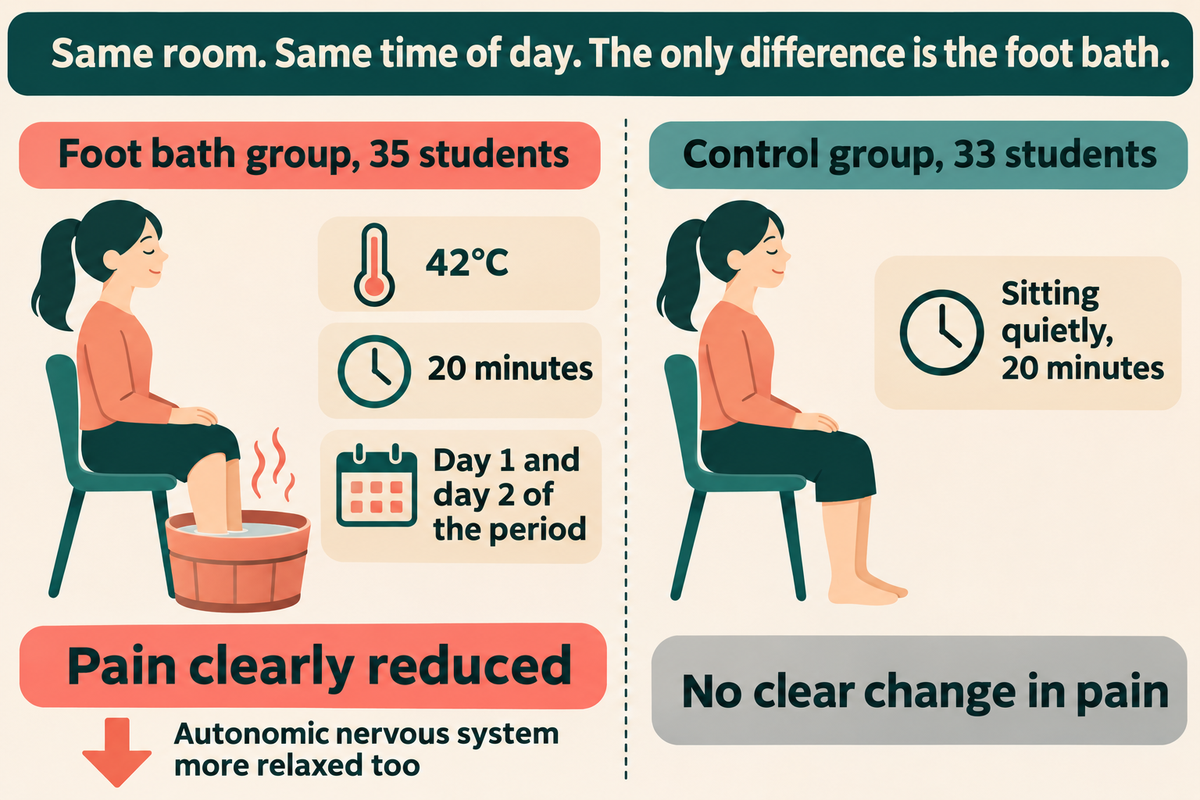
This study was run by Wu Shu-Jen and colleagues at a nursing college in northern Taiwan, published in 2022 in the British journal *Journal of Obstetrics and Gynaecology*, and registered on the clinical trial registry of the United States National Institutes of Health (number NCT04071028).note 1 It recruited 68 female students aged 16 to 20 who had regular periods and period pain of 5 or more on a 10-point scale, randomly split into two groups: 35 in the foot bath group, 33 in the control group.
A "randomised controlled trial" is one of the most credible designs in medical research: people of similar condition are divided into two groups by lot, one given the intervention (the foot bath) and one not, with every other condition kept as alike as possible, so that any difference can be put down to the foot bath itself rather than to one group happening to be in better shape.
| Parameter | Foot bath group | Control group |
|---|---|---|
| When it was done | Day 1 and day 2 of the period, once each | Attending in the same time slot |
| Place and time of day | A quiet air-conditioned room, 5:30 to 6:30 in the evening | As at left |
| Preparation | 20 minutes of sitting quietly first | 20 minutes of sitting quietly first |
| The intervention | Lower legs into 42 °C hot water, water level above the ankle (the height of the Sanyinjiao point), with bubbles and vibration massage at the sole, soaking for 20 minutes | Carry on sitting quietly for 20 minutes, no foot bath |
| Measures | 10-point pain scale, Short-Form McGill Pain Questionnaire, heart rate variability (a marker of the autonomic nervous system) | As at left |
The control group was not told to do nothing and go home. They came to the same room in the same time slot and sat quietly just as the foot bath group did, the one difference being that their feet did not go into hot water. That design matters: it rules out the possibility that people simply hurt less because they had sat down and rested.
What this study let everyone see
After soaking, pain scores in the foot bath group were clearly lower than the control group's; and heart rate variability in the foot bath group improved clearly too, the body moving from "tense" in the direction of "relaxed".note 1
The research team did one thing more: they set each person's change in heart rate variability alongside how much their pain eased, and found the two positively correlated, which is to say the more a person's autonomic nervous system relaxed, the more their pain improved. That gives "why soaking the feet helps" an explanation that can be measured, rather than only "it feels more comfortable".
Worth noting is that this study looked only at the effect in the moment on day 1 and day 2 of the period, and did not follow whether soaking across several consecutive cycles builds a larger effect; the participants were also all students aged 16 to 20. So what it can tell us is that "soaking the feet while period pain is happening will feel somewhat more comfortable", and as for whether soaking every month over the long run leaves less and less pain, there is no answer yet.
Beyond Taiwan: what 57 trials add up to
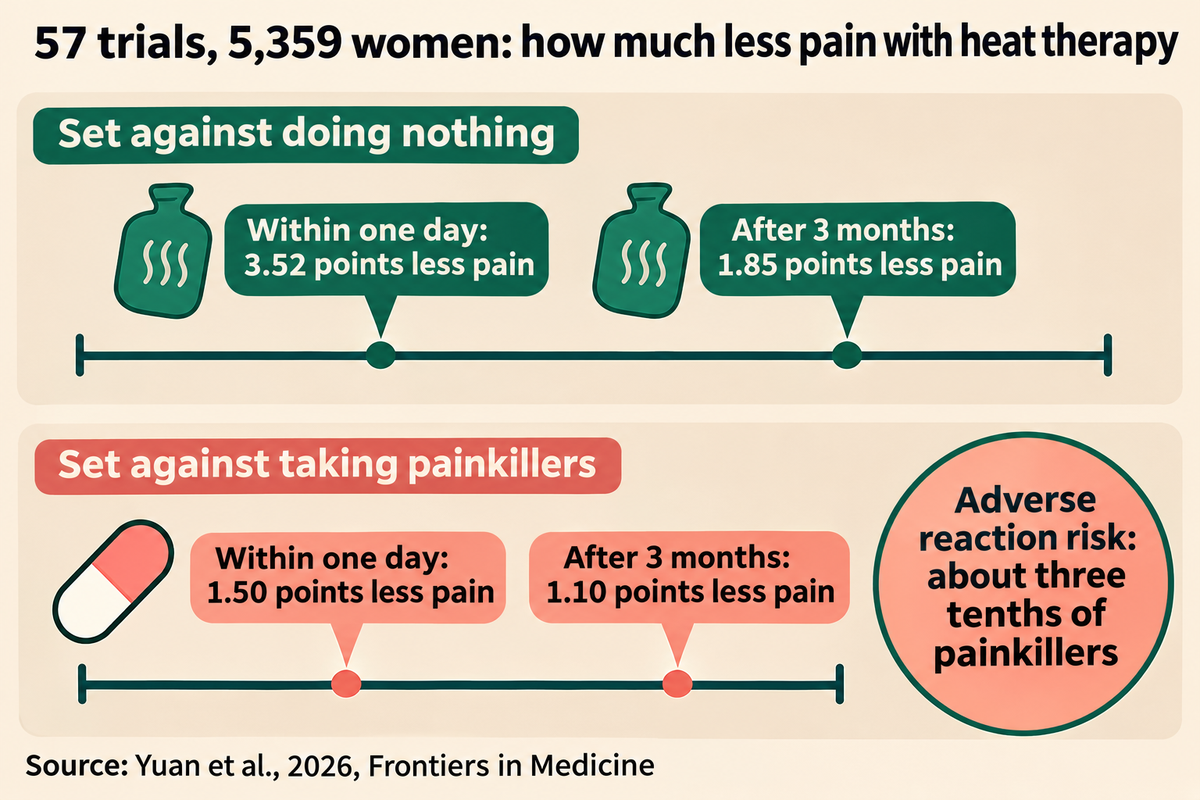
The Taiwanese study is no isolated case. In 2026, Yuan and colleagues published a meta-analysis in *Frontiers in Medicine* taking in 57 randomised controlled trials and 5,359 women in all, comparing various forms of heat therapy for primary dysmenorrhoea.note 2 Converted to a pain score on a 0 to 10 scale, the results read:
| Way of easing pain | Within one day of use | After 3 months of continuous use |
|---|---|---|
| Heat therapy (set against doing nothing) | 3.52 points less pain | 1.85 points less pain |
| Heat therapy (set against taking painkillers) | 1.50 points less pain | 1.10 points less pain |
A larger number means the heat therapy group hurt that much less than the comparison group did. On side effects, the risk of an adverse reaction with heat therapy is only around three tenths of that with painkillers.
Put another way, this meta-analysis holds that the pain relief from heat therapy may be close to that from painkillers, with fewer adverse reactions. The authors also caution that the forms and temperatures of heat therapy across these trials were not all the same, and that the pain-relief result set against painkillers is low-certainty evidence, which is why the conclusion is put as "may" rather than "will".
The conclusion is not in fact new. As early as 2001, Akin's team in the United States published a tightly designed trial in *Obstetrics & Gynecology*: 84 women used, respectively, a heating patch, ibuprofen, both together, or a placebo with no effect at all, recording their pain over 2 consecutive days. The heating patch used on its own relieved pain as well as ibuprofen did; using both together did not push the final degree of relief any higher, but the time until pain was first noticeably eased shortened from 2.8 hours to 1.5 hours.note 5 In 2012 Navvabi Rigi's team in Iran ran it again with 147 students, and also arrived at the conclusion that "a heating patch and ibuprofen are comparable".note 5
Why can soaking the feet in hot water ease period pain?
Why might heat help? The explanations researchers put forward are easier to follow through two everyday comparisons. First, to be clear: most of these explanations come from research round-ups on ordinary heat application, and whether a foot bath takes the same route has not yet been directly confirmed by a trial.
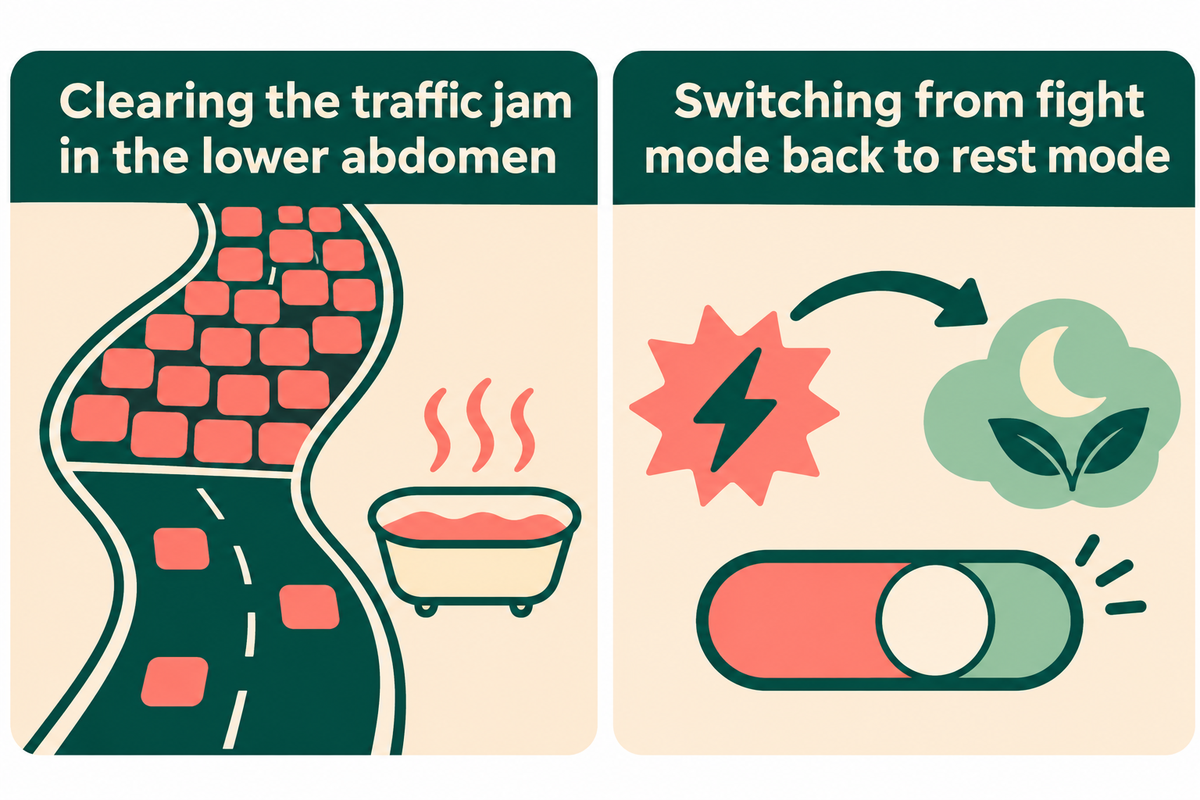
First, like clearing a traffic jam. During period pain the uterine muscle contracts hard, local blood flow worsens and the tissue goes short of oxygen, like a road that is blocked and hurts more the longer it stays blocked. Review research on heat therapy holds that warmth may improve local blood flow and relax the muscle, and that as the jam eases, cramping and pain may ease along with it.note 2
Second, like switching the body out of "fight mode" back into "rest mode". The autonomic nervous system has two halves: one in charge of tension and alertness, one in charge of relaxation and repair. This Taiwanese trial found that heart rate variability (the marker reflecting the state of the autonomic nervous system) improved in the foot bath group, and that those whose improved more also had more pain relief. The two appearing together is a clue that "relaxation may help", but it is not yet possible to say relaxation is the reason the pain eased.note 1
As for whether heat can directly reduce prostaglandin, no study has directly measured what a foot bath does to prostaglandin. The 2026 review article by Puhakka's team drawing together heat therapy research in women's health lists blood flow, muscle relaxation and pain modulation as possible reasons; what it draws together is ordinary heat application, not a direct trial of foot bathing.note 2
Looking at foot bath studies from other countries for the differences in detail
Research in different places points the same way, while the details differ one from another, which is worth noting.
- A systematic review from South Korea (2018): Jo and Lee pooled 6 randomised controlled trials and found heat therapy slightly better than painkillers (274 people across two studies), and much better than doing nothing (on average 4 points lower on the pain scale). The authors stress, though, that both the number of studies and the number of people included were on the small side, which puts the conclusion at "there is supportive evidence, larger studies are still needed".note 2
- A foot bath trial from Turkey (2026): Yücesoy and Erbil had 78 female university students with premenstrual syndrome soak their feet every evening in water at 38 to 42 °C for 7 to 10 days before the period, across 3 consecutive cycles. Total premenstrual syndrome scores and the sub-scores for pain, fatigue and irritability all improved clearly, and facets of the quality-of-life scale such as bodily pain and vitality also made progress; sleep quality, however, did not reach statistical significance against the control group. This study looked at what soaking the feet "before the period arrives" does for premenstrual discomfort, unlike the Taiwanese study's look at "the period as it happens", and the two happen to complement each other.note 1
- The heating patch trials from Iran and the United States: both Akin (2001) and Navvabi Rigi (2012), mentioned above, used heating patches stuck on the lower abdomen rather than foot baths, so their results cannot be set equal to soaking the feet; but they are the earliest, and the most often cited, evidence for the conclusion that "heat is as effective as painkillers".note 5
Doing it at home: a set-up drawn from the studies
What follows is drawn together from the actual set-ups in the studies above, offered for reference. It is not a medical prescription.
| Item | As done in the studies | How you can do it at home |
|---|---|---|
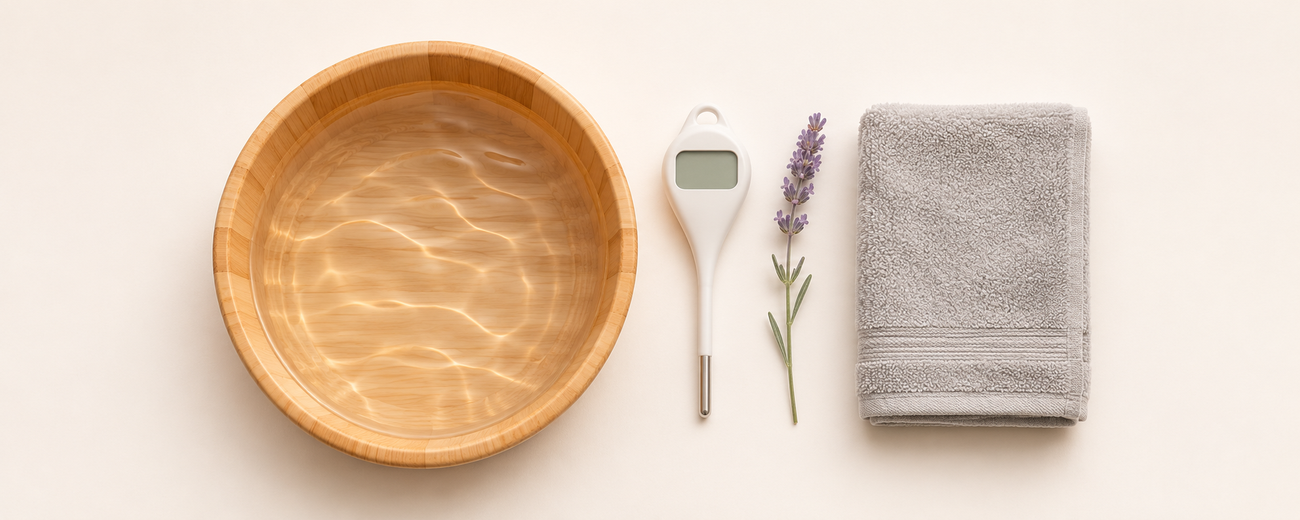
| Water temperature | 42 °C in the Taiwanese study; 38 to 42 °C in the Turkish study | 38 to 42 °C, measured with a thermometer rather than judged by feel |
| Duration | 20 minutes each time | 20 minutes; top it up with hot water if it goes cool partway |
| Water level | About four finger-widths above the ankle (the Sanyinjiao point) | Use a deeper bucket, with the water over the ankle |
| When | Taiwanese study: day 1 and day 2 of the period; Turkish study: every evening for 7 to 10 days before the period | Soak on the two worst days at the start, or every evening from about a week before the period is due |
| Setting | A quiet room, sitting down to rest first | Turn off phone notifications and treat it as 20 minutes of rest |
A few common questions, answered at once:
- Does it have to be a full 20 minutes? The Taiwanese and Turkish studies both used 20 minutes, and that is the length with the most complete data at present.
- Is hotter better? The studies run from 38 to 42 °C; above that there is no further evidence, and there is a scalding risk instead. Those with more sensitive skin on the feet, and older people, are advised to take the lower end.
- Which day of the period? The Taiwanese study used day 1 and day 2, which is when it hurts most; in the meta-analysis, the pain relief "within 24 hours" was also the most pronounced.
- Does one soak work? The Taiwanese study showed a difference there and then; as for whether soaking for several months running builds an effect, existing research has not settled it, so there is no need to expect one soak to "cure" anything.
Medical boundaries: when soaking on your own is not suitable
In the situations below, please see a doctor rather than handling it yourself with a foot bath:
- Known or suspected endometriosis, uterine fibroids or pelvic inflammatory disease: this kind of "secondary dysmenorrhoea" needs diagnosis and treatment from a gynaecologist, and a foot bath is no substitute.
- Known vascular or leg circulatory disease (deep vein thrombosis, for instance): let a healthcare professional assess it first, then decide whether to use a warm foot bath.
- Dulled sensation in the feet (diabetic peripheral neuropathy, for example): you cannot feel the heat, which makes it easy to be scalded without noticing.
- Pain at this level means going straight to a doctor: pain that stops you standing straight or breaks your speech up, that leaves you in a cold sweat or nauseous even after painkillers, that means taking leave and lying down; or pain that comes with fever, abnormal bleeding, or an area that keeps widening. In medical terms this is roughly 8 or more on a 10-point scale, but you do not need to score yourself first: any one of the above appearing is reason to see a doctor.
- Severe abdominal pain that comes on suddenly during the period: rule out emergencies such as appendicitis or ovarian torsion first, before talking about any relief at home.
This article only draws together research information. It does not constitute medical advice and is no substitute for gynaecological or other medical assessment.
Further reading
- Cold Hands and Feet Keeping You Awake? The Science of Peripheral Circulation and the Pre-Sleep Footbath
- How Warm Is a 41°C Footbath? Water Temp, Timing & a 10-Minute Pre-Sleep Ritual
- No Bathtub? No Problem. A Complete Guide to Foot Baths, Half Baths, and Full Baths with Beitou White Sulfur Powder
Sources
- Armour, M., Parry, K., Manohar, N., Holmes, K., Ferfolja, T., Curry, C., MacMillan, F., & Smith, C. A. (2019). The prevalence and academic impact of dysmenorrhea in 21,573 young women: A systematic review and meta-analysis. *Journal of Women's Health*, 28(8), 1161-1171. https://doi.org/10.1089/jwh.2018.7615
- Wu, S.-J., Kan, W.-C., & Shiao, C.-C. (2022). Warm-water footbath improves dysmenorrhoea and heart rate variability in college students: A randomised controlled trial. *Journal of Obstetrics and Gynaecology*, 42(5), 1204-1210. https://doi.org/10.1080/01443615.2021.1945007 (Trial registration: ClinicalTrials.gov NCT04071028)
- Yuan, D., Liu, Y., Chen, Z., Hu, Z., Li, X., Zhang, W., Mao, K., Ma, W., & Lan, L. (2026). Heat therapy for primary dysmenorrhea: A systematic review and meta-analysis. *Frontiers in Medicine*, 12, 1730505. https://doi.org/10.3389/fmed.2025.1730505
- Jo, J., & Lee, S. H. (2018). Heat therapy for primary dysmenorrhea: A systematic review and meta-analysis of its effects on pain relief and quality of life. *Scientific Reports*, 8, 16252. https://doi.org/10.1038/s41598-018-34303-z
- Akin, M. D., Weingand, K. W., Hengehold, D. A., Goodale, M. B., Hinkle, R. T., & Smith, R. P. (2001). Continuous low-level topical heat in the treatment of dysmenorrhea. *Obstetrics & Gynecology*, 97(3), 343-349. https://doi.org/10.1016/s0029-7844(00)01163-7
- Navvabi Rigi, S., Kermansaravi, F., Navidian, A., Safabakhsh, L., Safarzadeh, A., Khazaian, S., Shafie, S., & Salehian, T. (2012). Comparing the analgesic effect of heat patch containing iron chip and ibuprofen for primary dysmenorrhea: A randomized controlled trial. *BMC Women's Health*, 12, 25. https://doi.org/10.1186/1472-6874-12-25
- Orok, E., Aremu, B., Iheme, C., Odeleye, H., Ola-Amuda, I., Jogun-Omi, O., Yusuf, D., Ometan, P., Iwuoha, A., Fehintola, O., Ariyo, E., Ekada, I., & Usen, I. (2026). Nonsteroidal anti-inflammatory drug resistance in dysmenorrhea: A study of prevalence, predictors, and alternative pain management among Nigerian female students. *Reproductive Health*, 23(1), 173. https://doi.org/10.1186/s12978-026-02404-y
- Yücesoy, H., & Erbil, N. (2026). The effect of footbath on premenstrual syndrome, sleep quality, and quality of life in university students with premenstrual syndrome: A randomized controlled trial. *Journal of Integrative and Complementary Medicine*, 32(6), 521-535. https://doi.org/10.1177/27683605251392784
- Puhakka, A., Mechsner, S., Placek, K., Reis, J. L., Saccone, G., & Cagnacci, A. (2026). Superficial heat therapy in women's health. *Frontiers in Medicine*, 13, 1832193. https://doi.org/10.3389/fmed.2026.1832193
Guidelines and official resources
- ACOG (American College of Obstetricians and Gynecologists): Dysmenorrhea: Painful Periods https://www.acog.org/womens-health/faqs/dysmenorrhea-painful-periods
- WHO, gynaecology and obstetrics health topic: https://www.who.int/health-topics/gynaecology-and-obstetrics
Notes
note 1: The Taiwanese study (Wu et al., 2022; NCT04071028) involved nursing college students aged 16 to 20, enrolled from December 2013 to June 2014, with 35 in the foot bath group and 33 in the control group; the intervention was one 42 °C foot bath of 20 minutes on each of day 1 and day 2 of the period, in the evening (water level up to the Sanyinjiao point, with bubbles and vibration at the sole), while the control group sat quietly in the same time slot. Outcomes were assessed with a 10-point pain scale, the Short-Form McGill Pain Questionnaire and heart rate variability; the abstract reports significantly reduced pain and significantly improved autonomic activity in the foot bath group, with the change in heart rate variability positively correlated with the improvement in pain. The abstract does not give the exact scores for each group, and this article quotes no specific values; please check against the full text at fact-check. The Turkish study (Yücesoy & Erbil, 2026) involved 78 female university students with premenstrual syndrome, the intervention being a 38 to 42 °C foot bath every evening for 7 to 10 days before the period across 3 consecutive cycles, with no essential oils used; the main results were significant improvement in the total score and each sub-score of the Premenstrual Syndrome Scale (PMSS), while sleep quality (PSQI) improved within the group but did not reach significance between groups.
note 2: The meta-analysis values all come from the abstract of Yuan et al. (2026); the original uses a 10 cm visual analogue scale (VAS), where 1 cm corresponds to 1 point on a 10-point scale, and this article writes "points" throughout: vs no treatment at 3 months WMD -1.85 cm (25 RCTs, 2,393 people), within 24 hours WMD -3.52 cm (3 trials, 248 people); vs NSAIDs at 3 months WMD -1.10 cm (22 trials, 1,938 people), within 24 hours WMD -1.50 cm (2 trials, 167 people); adverse events RR 0.30 (8 trials, 728 people). "NSAIDs are ineffective for 18% of women" is a figure cited in that paper's introduction. The pain-relief result set against NSAIDs is low-certainty evidence; the adverse-event result is moderate-certainty. Jo and Lee (2018): vs painkillers SMD -0.72 (2 trials, 274 people), vs no treatment MD -4.04 VAS (1 trial, 132 people), 6 RCTs included in all. Puhakka et al. (2026) is a narrative review, offering a round-up of mechanisms rather than new foot bath trial evidence.
note 3: Armour et al. (2019) report a prevalence of 71.1% (37 studies, 20,813 people, 95% CI 66.6 to 75.2), a class absence rate of 20.1%, and classroom performance affected in 40.9%. The paper's population is young women aged under 25, and does not stand for every age group.
note 4: Orok et al. (2026) is a cross-sectional questionnaire survey (not a trial); of 271 Nigerian female university students, 70.8% had period pain, and among the 120 who had used NSAIDs, 63 (52.5%) met the definition of "pain persisting after taking the recommended dose", which is 32.8% of all those with period pain. This figure is self-reported and defined differently from the 18% cited by the meta-analysis; the two cannot be added together or compared directly.
note 5: Akin et al. (2001) used a double-blind double-dummy design with 84 people (81 completing), with an abdominal heating patch worn about 12 hours a day and ibuprofen 400 mg three times a day, over 2 consecutive days; pain relief in the heat patch plus placebo, placebo patch plus ibuprofen, and combined groups was all significantly better than in the double-placebo group, with the heating patch and ibuprofen comparable; the median time to noticeable relief in the combined group was 1.5 hours, against 2.79 hours for ibuprofen alone. Navvabi Rigi et al. (2012) studied 147 students aged 18 to 30, assessed with the Short-Form McGill Pain Questionnaire; pain in the heat patch group was slightly lower at 8, 12 and 24 hours but did not reach significance, and the conclusion was that the two are comparable. The intervention in both was an abdominal heating patch, not a foot bath.