
Other language versions: 中文 ・ 日本語
The short version
Legs aching the day after a hard session? Rolling out on a foam roller and then going over the sore spots with a massage gun has almost become the standard gym routine. But what are these "recovery tools" actually doing? Do they genuinely relax anything? This article works through the research item by item: every time a finding first appears, we say who ran the study, in what year, where it was published, what it actually found, and what its limitations are.
The article runs through six stops — click to jump to any section: why "feeling less sore" and "recovering faster" are two different things, foam rollers: what the studies actually measure, massage guns: the evidence is thinner than you would think, but a few things are clear, can foam rollers and massage guns substitute for each other?, heat packs, baths, light activity and complete rest, and when to stop treating it yourself, with an FAQ and further reading at the end. Start with this overview table — the table itself draws no research conclusions; specific results and citations are in each section:
| Method | Where it may help | What the studies mainly measure | Notes |
|---|---|---|---|
| Foam roller | Mostly short-term "feel" and joint range of motion; results run both ways | Subjective soreness scores, pressure-pain threshold (the pressure at which you start to feel pain, measured with an instrument), joint range of motion, sprint/jump/strength tests | Effect sizes, conflicting findings and study limitations are covered in Foam rollers: what the studies actually measure |
| Massage gun | Mostly short-term range of motion and how you feel while using it | Joint range of motion, subjective soreness, maximal voluntary contraction force, creatine kinase (CK, a blood marker that rises with muscle damage), leg volume, jump performance | The volume and design of the research differ from foam rolling; how large that gap is, and which studies make it up, is explained in the massage gun section |
| Heat packs | Mostly short-term changes in how pain feels | Subjective pain, maximal isometric strength (the greatest force a muscle can produce without changing length), proxies for tissue stiffness | Timing, evidence grade and funding background are covered study by study in Heat packs, baths, light activity and complete rest |
| Warm baths | Relaxation and in-the-moment relief | Subjective soreness, subjective fatigue, blood markers such as CK; water temperature is the key variable | Water temperature strongly shapes the results — see the named meta-analysis in Heat packs, baths, light activity and complete rest |
| Light activity | Changes in how you feel after low-intensity movement | Subjective soreness, subjective fatigue, blood markers; separate reviews cover strength and range of motion | Two named studies pointing in different directions are laid out side by side in Heat packs, baths, light activity and complete rest |
| Complete rest | Needs no equipment, and carries no risk of burns, overheating or a drop in blood pressure | The control condition in almost every study | For when things are beyond self-care, see the official health-authority sources in When to stop treating it yourself |
Read the table first, then work through the evidence. The core question the whole article deals with is this: are "feeling less sore" and "recovering faster" the same thing? The next section uses four named studies to show why they need to be kept apart.
Why "feeling less sore" and "recovering faster" are two different things
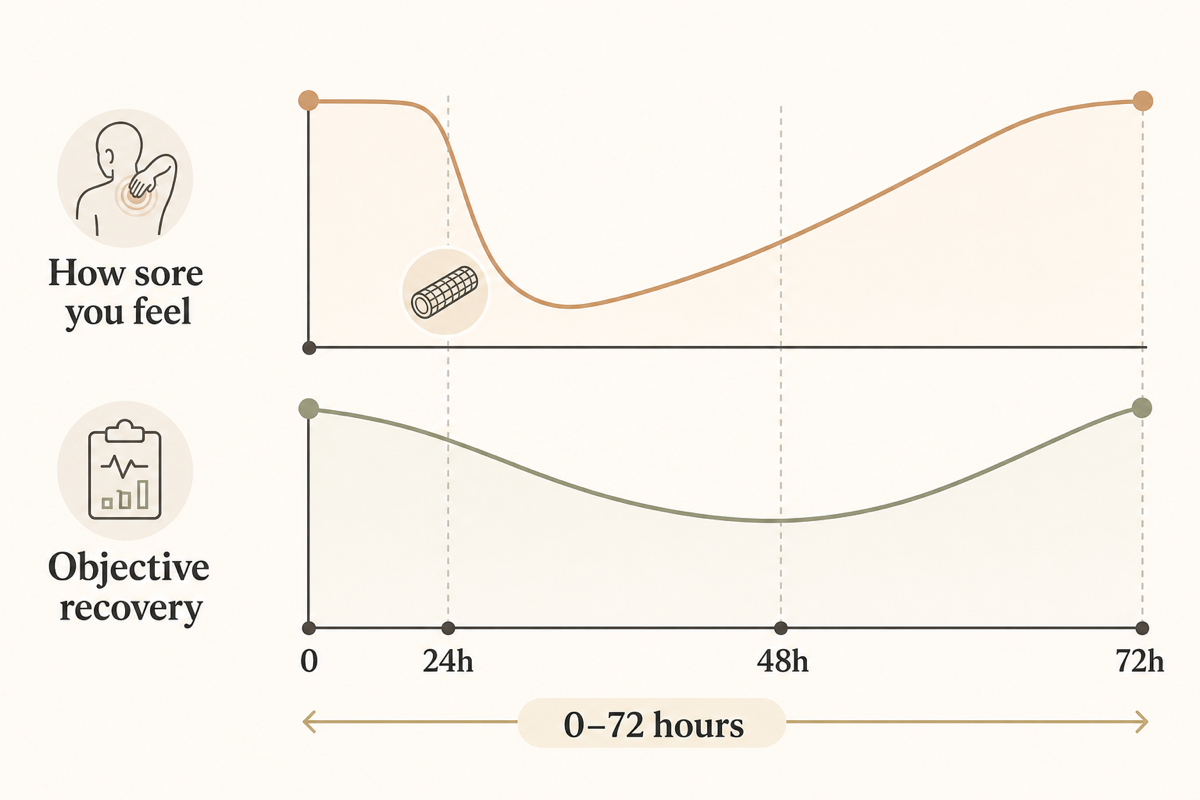
Research on delayed-onset muscle soreness (DOMS) usually measures two kinds of things at once: how sore you feel (subjective ratings), and where your body has actually recovered to (pressure-pain threshold, strength, swelling, blood markers of muscle damage, athletic performance). These two families of measures frequently give answers pointing in opposite directions.
A controlled study by Scudamore and colleagues, published in 2021 in the Journal of Exercise Science & Fitness (20 men and women), found that after soreness was induced, participants who foam rolled completed four simulated military tasks under load the next day — a loaded stair climb, a rush between cover positions, a simulated ammunition-box carry and a shuttle run — significantly faster than those who rested passively. Yet the two groups' self-rated soreness scores showed no significant difference: the body could move again, but it did not feel any less sore.
The reverse pattern exists too. A 2024 controlled trial by Roberts and colleagues in the Journal of Sports Science and Medicine measured "more comfortable right now" separately from "recovering faster": a massage gun lowered soreness ratings by about 2–3 points during use (on the NRS, a 0–10 pain self-rating scale), but the next day, pre-treatment soreness was identical to that of people who had not used one at all. Each group in this study had only 8–9 participants — a very small sample.
The same split shows up at the meta-analysis level. A 2024 meta-analysis by Zhou and colleagues in the Journal of Bodywork and Movement Therapies (a meta-analysis is a study that pools the data of multiple studies and re-analyses them; this one included 16 studies and 515 participants) found that post-exercise foam rolling produced a small reduction in self-rated soreness at 24–72 hours (largest at 48 hours, SMD −0.77; SMD is the "standardised mean difference", an effect-size measure — effect sizes convert differences onto a common scale where roughly 0.2 is small, 0.5 medium and 0.8 or above large). But pressure-pain threshold, measured with an instrument, showed no significant change at most time points. The scales that moved were subjective ones; what changed was more likely the feeling, not necessarily the tissue itself.
Keep that axis in mind as we go through the tools one by one, and single numbers will be much less likely to lead you astray.
Foam rollers: what the studies actually measure
Subjective soreness: small, and the results are split. The Zhou 2024 meta-analysis above found small-to-moderate improvements in soreness scores. But another meta-analysis by Medeiros and colleagues, published in 2023 in the same journal, applied the strictest inclusion rule — control groups had to receive no intervention at all — and could find only 5 studies with 151 participants (136 of them male). Foam rolling or stick massage showed no significant difference from control on soreness anywhere from 0 to 96 hours, and none on range of motion, swelling or isometric strength either; the authors rated the included studies as being at moderate-to-high risk of bias. High-quality research remains insufficient, and no firm verdict can be drawn yet.
The 2019 meta-analysis by Wiewelhove and colleagues in Frontiers in Physiology (21 studies) is often cited as evidence that foam rolling works, but the original conclusions are quite conservative: rolling after exercise improved muscle pain by about 6% (g=0.47) and sprint recovery by about 3.1% (g=0.34), with essentially no effect on jumping (g=0.06). The authors describe the overall effects as "rather minor and partly negligible", and argue the evidence better supports using a roller as a warm-up tool than as a recovery tool.
A null result with a lot of explanatory power. A 37-person controlled trial by D'Amico and Gillis, published in 2019 in the Journal of Strength and Conditioning Research, had participants foam roll for 5 consecutive days after sprint-induced muscle damage (2 sets of 60 seconds per body area). Self-rated soreness, tenderness, hamstring length, hip-abduction range of motion and vertical jump were all no different from control; only the agility T-test was significantly better. The authors' explanation is a useful one: both groups performed the same full dynamic warm-up before every test — and the warm-up itself may already have delivered whatever the foam roller was supposed to provide. Anyone citing this study should also note: the two groups' baseline vertical jump and agility were significantly unbalanced to begin with, and the rollers used in the study were donated by a manufacturer.
The most solid evidence is actually for range of motion. A 2020 meta-analysis by Skinner and colleagues in the Journal of Bodywork and Movement Therapies (32 studies, average PEDro quality score 5.56; PEDro is a widely used 0–10 methodological quality scale for physiotherapy research) found a large effect of foam rolling on joint range of motion (d=0.76, 95% CI 0.55–0.98; a "95% CI" is a 95% confidence interval, the range in which the true effect most plausibly lies), but could not establish any direct benefit to athletic performance beyond that — and found no evident harm either. A 2022 meta-analysis by Konrad and colleagues in Sports Medicine (11 studies, 290 participants) adds detail: several weeks of foam-rolling training increases range of motion moderately (ES=0.823, p=0.001), but only becomes significant after more than 4 weeks, and the effect is site-specific — rolling the calf did not improve ankle dorsiflexion. Heterogeneity across studies was high (I²=72.76; heterogeneity describes how inconsistent the individual studies' results are with each other — the higher the number, the more they diverge).
The mechanism points to the nervous system rather than the muscle. A 2014 trial by Macdonald and colleagues in Medicine & Science in Sports & Exercise (20 resistance-trained men, only 10 per group) did something rare: it measured the actual pressure applied, finding participants pressed on the roller with about 32–55% of body weight (26–46 kg). The study found reduced soreness and increased range of motion at the same time as some evoked contractile properties of the muscle actually got worse; the researchers' own inference is that the benefits come mainly from neural responses and connective tissue, not from the muscle being "repaired". Worth noting alongside: the most frequently cited positive primary study — the 2015 crossover trial by Pearcey and colleagues in the Journal of Athletic Training — had only 8 male participants, no placebo control and relatively lenient statistics, and cannot on its own support the conclusion that "foam rolling works".
In short: a foam roller can make you feel somewhat better and move more freely; what cannot be demonstrated is that it works as a tool to speed up muscle repair.
Massage guns: the evidence is thinner than you would think — but a few things are clear
Start with a structural fact: foam rolling has 5 meta-analyses with pooled effect sizes; massage guns to date have 0. The three existing syntheses — a 2023 systematic review by Ferreira and colleagues in the Journal of Functional Morphology and Kinesiology (a systematic review is a study that comprehensively collects and appraises the literature by a predefined method; this one included 11 studies, of which 10 were at moderate risk of bias and 0 at low risk), a 2023 systematic review by Sams and colleagues in the International Journal of Sports Physical Therapy (13 studies, about 255 participants, with the authors stating that every included study had methodological or reporting flaws), and a 2026 rapid scoping review by Isaji and colleagues (a review type that rapidly maps the scope and gaps of a field) — all remain at the narrative level. The two tools' evidence differs in thickness, which is why this article presents them separately — and why claims online that put the two side by side as equally evidence-backed currently have no basis in the literature.
What is established: short-term range of motion. A 2020 randomised crossover trial by Konrad and colleagues in the Journal of Sports Science and Medicine (16 healthy men) applied a Hypervolt device to the calf for 5 minutes: ankle dorsiflexion increased immediately by an average of 5.4 degrees (about 18%), with no drop in maximal voluntary contraction force — an increase comparable to the same team's earlier study of 5 minutes of static stretching. Note carefully: this study never measured soreness at any point.
On soreness: the only stronger positive evidence comes with very specific conditions. A 2025 three-arm randomised controlled trial by Li and colleagues in Frontiers in Public Health (30 male college students, only 10 per group) found that after squat-induced soreness, two 40-minute massage-gun sessions (53 Hz, 6 mm amplitude, administered by a physical therapist) produced significantly lower pain scores at 48 hours than static stretching; but in the same study, the 25-minutes-per-session group did no better than stretching. The comparison group did static stretching — there was no placebo arm. Separately, a 2025 randomised trial in the Clinical Journal of Sport Medicine with 84 runners and a sham-treatment comparison found that massage-gun use on the quadriceps left subjective pain, fatigue and perceived recovery better, but vertical jump height showed no difference.
The other side: the advantage disappears against simply lying down. A 2024 three-arm randomised controlled trial by Heinke and colleagues in Frontiers in Physiology (34 participants: massage gun vs cold-water immersion vs passive rest) applied a 12-minute intervention after downhill running plus drop jumps to exhaustion and followed participants for 72 hours: the massage gun was no better than plain passive rest on muscle soreness, creatine kinase, leg volume or any jump test; only the subjective feeling of stiffness dropped briefly right after use. Put together with the Roberts 2024 finding above ("2–3 points lower in the moment, back to zero the next day"), the currently reasonable positioning of massage guns is: immediate, temporary relief of how things feel.
Using it too long may backfire. A 2023 crossover study by Canbulut and colleagues in the Turkish Journal of Sports Medicine (24 participants, including 10 women) found that after 8 minutes at 30 Hz on the quadriceps, hip-flexion range of motion improved by only 2.8 degrees, jumps and agility did not change, and peak power in the anaerobic test dropped significantly by about 9% (456 W → 414 W, p=0.006). The authors' conclusion: using a percussive device as a warm-up may impair anaerobic performance.
What we still do not know. The 2026 scoping review by Isaji and colleagues (search up to April 2025) points out that across the entire massage-gun literature, only four studies followed any time point beyond the treatment session itself, so long-term effects are unknown; adverse events are rare but clinically meaningful, mostly arising from overuse, unsupervised use, or use on anatomically vulnerable sites. Dosing in the literature spans 1 to 40 minutes per session and 30–53 Hz, entirely unstandardised — which is why this article gives no "recommended minutes" figure. Note also that in every verified trial to date the device was applied by researchers, therapists or coaches; using one on yourself at home may not produce the same results.
For practical boundaries, the 2023 patient guidance from physical therapist Gary Calabrese at Cleveland Clinic is a reasonable reference: start at the lowest intensity, move slowly, do not stay on one muscle group for more than a few minutes, do not press down harder (extra pressure can cause injury), and avoid bony prominences; people with chronic conditions or recovering from injury should consult their care team first. The same guidance states plainly: these devices have not been shown to improve speed, power or endurance.
Can foam rollers and massage guns substitute for each other?
There are currently no verified head-to-head "foam roller vs massage gun" trials, so the two can only be described separately — neither can be ranked above the other. From the existing evidence, where they overlap is short-term range of motion and subjective relief; where they differ is mainly evidence thickness (roller > gun) and context of use — a roller is cheap and offers a wide, controllable pressure range but needs floor space; a gun is convenient for targeting one spot and does not require lying down, but its dosing is unstandardised and it carries the risk of pressing too hard. Choose by lifestyle — and treat neither as a choice of therapy.
Heat packs, baths, light activity and complete rest: one framework for all four
We covered these four approaches in full in an earlier deep-dive, Sore the Day After Exercise? What DOMS Research Actually Says About Hot Water, Cold Water, and Stretching; here they are only compressed into the same "feeling vs objective recovery" framework.
Heat packs: a 2022 network meta-analysis by Wang and colleagues in the Journal of Rehabilitation Medicine comparing ten heat and cold interventions (a network meta-analysis can rank multiple treatments inside one framework; 59 studies, 1,367 participants) placed heat packs near the top of the ranking for pain relief within 24–48 hours after exercise; the authors caution in the same paper that the included studies' quality is limited, so the conclusion is not firm. Timing may matter a great deal: a 2013 trial by Petrofsky and colleagues in the Journal of Clinical Medicine Research with 100 participants — funded by heat-wrap manufacturer Pfizer/ThermaCare — found that applying heat immediately after exercise left next-day quadriceps strength only about 4% down, against roughly 24% in untreated controls; waiting until 24 hours later helped much less. The evidence grade deserves a discount: a 2025 umbrella review by Wiecha and colleagues in Sports Medicine (an umbrella review is a top-level review that aggregates multiple systematic reviews; 29 systematic reviews covering 863 RCTs) placed heat therapy for pain at level-4 evidence (a low tier in evidence-grading systems) — the effect size is large (g=1.82) but the confidence interval is very wide, and 17 of the 29 reviews were rated critically low in methodological quality.
Baths: in the 2018 meta-analysis by Dupuy and colleagues in Frontiers in Physiology, which included 99 studies, warm-water immersion at 36°C or above was the only immersion condition that failed to reach statistical significance (SMD +0.53, 95% CI −0.44 to 1.51 — crossing zero); the immersions that produced significant pain relief were mainly cold water at 15°C or below. So the reasonable positioning of a warm bath is: comfortable, relaxing, temporarily easing the feeling of soreness — which has value in itself, but should not be read as evidence of faster recovery. (Safety limits are at the end of this article.)
Light activity: in the same Dupuy 2018 meta-analysis, active recovery (low-intensity activity) produced a significant but modest improvement in soreness scores (SMD −0.94). But the 2018 cool-down review by Van Hooren and Peake in Sports Medicine offers the other side: in most studies, an active cool-down did not significantly reduce delayed-onset soreness, nor did it improve muscle-damage markers, tendon stiffness or range of motion. The practical reading of the two together: a walk or easy spin is generally harmless and may make you feel a bit better — just do not expect it to override the natural recovery timetable.
Complete rest: it is the control condition in nearly every study, and DOMS itself is self-limiting — it resolves on its own with time. The Heinke 2024 trial is a reminder that within a 72-hour window, "doing nothing" did not lose to the tools.
When to stop treating it yourself
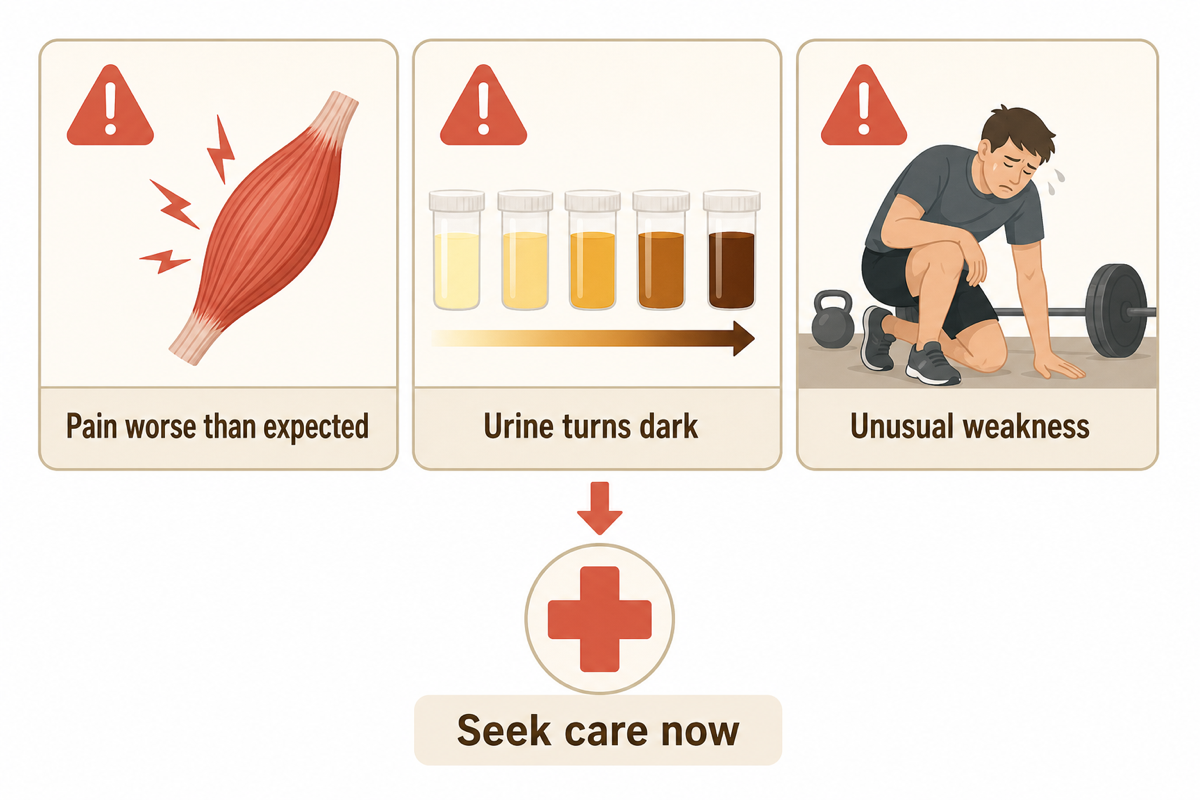
Most post-exercise soreness eases by itself within 2–3 days. The following situations are beyond "soreness relief", and are collected here in one place:
The US CDC/NIOSH patient guidance on rhabdomyolysis (an emergency in which large numbers of muscle cells die and release their contents into the blood, potentially injuring the kidneys) names three warning signs: muscle soreness "worse than expected", urine the colour of tea or cola, and being too weak to complete a workload you would normally finish — any one of these means seek medical care immediately. Symptoms can appear hours to days later, and symptoms alone cannot settle the question: a blood test for creatine kinase (CK) is needed. The clinical reference StatPearls adds that the typical combination is muscle weakness, pain, local swelling and deep reddish-brown urine; recognised early, the outlook is comparatively good, while delay can progress to acute kidney injury or compartment syndrome (an emergency in which pressure inside a muscle compartment rises high enough to compress vessels and nerves).
Massage guns are not zero-risk: in 2021, Physical Therapy published the first reported case of massage-gun-associated rhabdomyolysis — a user with untreated iron-deficiency anaemia had the device applied to both thighs by a coach for about 10 minutes after exercise, then developed severe muscle pain, extensive bruising and tea-coloured urine, with creatine kinase peaking at 32,290 U/L (the normal upper limit is about 195). She recovered after two weeks in hospital. A case report means "this can happen", not that it is common — but it is worth keeping in mind.
Heat has limits too: StatPearls notes that repeated, prolonged heating of the same area — even below 45°C, short of a burn — can cause erythema ab igne (a net-like pattern of redness and pigmentation), with heat packs and hot-water bottles among the common causes; management is to stop the heat source, and the pigmentation can take months to years to fade. The UK NHS guidance on burns and scalds: if a burn happens, cool it immediately under running water for 15–30 minutes, apply no creams or ointments, do not burst blisters, and seek immediate care for large or deep burns. For bathing, the 2025 guidance from Dr Melissa Young at Cleveland Clinic sets the ceiling: water at or below 40°C, no more than 15 minutes per soak, and hydrate; people who are pregnant, have cardiovascular disease or low blood pressure, have been drinking alcohol, have a history of epilepsy, or have open wounds should avoid it or consult a clinician first.
FAQ
Which is more effective, a foam roller or a massage gun? There are no verified head-to-head trials, so no comparison can be made. Foam rolling has more research behind it (5 meta-analyses with pooled effect sizes) and massage guns less (0); both are most reliable for short-term range of motion and subjective relief. Choose based on budget, space and how you like to use them.
How long should a massage gun be used at a time? Study dosing runs from 1 to 40 minutes and is entirely unstandardised, so no evidence-based number of minutes can be given. Cleveland Clinic's guidance points in this direction: start at the lowest intensity, move slowly, no more than a few minutes on one muscle group, do not add pressure, avoid bony prominences.
Does a hot bath help sore muscles after exercise? In a meta-analysis of 99 studies, warm-water immersion at 36°C or above did not reach statistical significance for soreness scores; a bath's value lies in in-the-moment relaxation and relief. Water at or below 40°C for no more than 15 minutes per soak is the safer envelope. For the full picture, see Sore the Day After Exercise? What DOMS Research Actually Says.
How sore is sore enough to see a doctor? Pain worse than expected, urine as dark as strong tea or cola, weakness that stops you finishing your usual workload, obvious local swelling or inability to bear weight — any one of these calls for immediate medical care, and a blood CK (creatine kinase) test is what settles it.
Further reading
- Sore the Day After Exercise? What DOMS Research Actually Says About Hot Water, Cold Water, and Stretching
- Is a hot spring better than a hot bath? Heat, water pressure and buoyancy, and what the balneotherapy evidence really shows
- You Slept In All Weekend — So Why Are You Still Tired on Monday? The Science of Sleep Debt, Social Jet Lag & Your Body Clock
Sources
- Zhou J, Jia D, Mao J, Xu Y (2024). Preventive effect of foam rolling on muscle soreness after exercise: A systematic review and meta-analysis. Journal of Bodywork and Movement Therapies 40:1890–1898. https://pubmed.ncbi.nlm.nih.gov/39593540/
- Medeiros F, et al. (2023). Acute effects of foam roller or stick massage on indirect markers from exercise-induced muscle damage in healthy individuals: A systematic review and meta-analysis. Journal of Bodywork and Movement Therapies 35:273–283. https://pubmed.ncbi.nlm.nih.gov/37330781/
- Wiewelhove T, et al. (2019). A Meta-Analysis of the Effects of Foam Rolling on Performance and Recovery. Frontiers in Physiology 10:376. https://www.frontiersin.org/journals/physiology/articles/10.3389/fphys.2019.00376/full
- Pearcey GEP, et al. (2015). Foam rolling for delayed-onset muscle soreness and recovery of dynamic performance measures. Journal of Athletic Training 50(1):5–13. https://pubmed.ncbi.nlm.nih.gov/25415413/
- Macdonald GZ, Button DC, Drinkwater EJ, Behm DG (2014). Foam rolling as a recovery tool after an intense bout of physical activity. Medicine & Science in Sports & Exercise 46(1):131–142. https://pubmed.ncbi.nlm.nih.gov/24343353/
- Scudamore EM, et al. (2021). Effects of foam rolling for delayed onset muscle soreness on loaded military task performance and perceived recovery. Journal of Exercise Science & Fitness 19(3):166–170. https://pubmed.ncbi.nlm.nih.gov/33786041/
- Skinner B, Moss R, Hammond L (2020). A systematic review and meta-analysis of the effects of foam rolling on range of motion, recovery and markers of athletic performance. Journal of Bodywork and Movement Therapies 24(3):105–122. https://nectar.northampton.ac.uk/id/eprint/12849/
- D'Amico AP, Gillis J (2019). Influence of Foam Rolling on Recovery From Exercise-Induced Muscle Damage. Journal of Strength and Conditioning Research 33(9):2443–2452. https://journals.lww.com/nsca-jscr/Fulltext/2019/09000/Influence_of_Foam_Rolling_on_Recovery_From.17.aspx
- Konrad A, Nakamura M, Tilp M, Donti O, Behm DG (2022). Foam Rolling Training Effects on Range of Motion: A Systematic Review and Meta-Analysis. Sports Medicine 52(10):2523–2535. https://link.springer.com/article/10.1007/s40279-022-01699-8
- Ferreira RM, et al. (2023). The Effects of Massage Guns on Performance and Recovery: A Systematic Review. Journal of Functional Morphology and Kinesiology 8(3):138. https://pubmed.ncbi.nlm.nih.gov/37754971/
- Konrad A, Glashüttner C, Reiner MM, Bernsteiner D, Tilp M (2020). The Acute Effects of a Percussive Massage Treatment with a Hypervolt Device on Plantar Flexor Muscles' Range of Motion and Performance. Journal of Sports Science and Medicine 19(4):690–694. https://www.jssm.org/mobile/fulltextmobile.php?id=jssm-19-690.xml
- Sams L, Langdown BL, Simons J, Vseteckova J (2023). The Effect Of Percussive Therapy On Musculoskeletal Performance And Experiences Of Pain: A Systematic Literature Review. International Journal of Sports Physical Therapy 18(2). https://ijspt.scholasticahq.com/article/73795
- Chen J, Zhang F, Chen H, Pan H (2021). Rhabdomyolysis After the Use of Percussion Massage Gun: A Case Report. Physical Therapy 101(1):pzaa199. https://academic.oup.com/ptj/article/101/1/pzaa199/5958507
- Li H, Luo L, Zhang J, Cheng P, Wu Q, Wen X (2025). Three-arm randomised controlled trial (percussive massage and DOMS). Frontiers in Public Health 13. https://www.frontiersin.org/journals/public-health/articles/10.3389/fpubh.2025.1561970/full
- Percussive massage improved quadriceps pain (randomised trial with sham comparison, 84 runners) (2025). Clinical Journal of Sport Medicine 35(4):431–434. https://journals.lww.com/cjsportsmed/abstract/9900/percussive_massage_improved_quadriceps_pain.315.aspx
- Cleveland Clinic — Gary Calabrese, DPT (2023). Are Massage Guns (for Percussive Therapy) Worth It? Cleveland Clinic Health Essentials. https://health.clevelandclinic.org/are-massage-guns-for-percussive-therapy-worth-it
- Canbulut A, Kıyak G, Ercan S, Çetin C (2023). Crossover controlled study (percussive massage and anaerobic performance). Turkish Journal of Sports Medicine 58(2):55–60. https://journalofsportsmedicine.org/full-text/690/eng
- Isaji Y, Muraoka H, Okuyama K, Fukaya T, Nakamura M (2026). Rapid scoping review (percussive therapy). Sport Sciences for Health 22:116. https://link.springer.com/article/10.1007/s11332-026-01701-0
- Roberts TD, Costa PB, Lynn SK, Coburn JW (2024). Controlled trial (percussive therapy and DOMS). Journal of Sports Science and Medicine 23:126–135. https://www.jssm.org/volume23/iss1/cap/jssm-23-126.pdf
- Heinke L, et al. (2024). Three-arm randomised controlled trial (percussive therapy vs cold-water immersion vs passive rest). Frontiers in Physiology 15. https://www.frontiersin.org/journals/physiology/articles/10.3389/fphys.2024.1432009/full
- Dupuy O, Douzi W, Theurot D, Bosquet L, Dugué B (2018). An Evidence-Based Approach for Choosing Post-exercise Recovery Techniques to Reduce Markers of Muscle Damage, Soreness, Fatigue, and Inflammation: A Systematic Review With Meta-Analysis. Frontiers in Physiology 9:403. https://www.ncbi.nlm.nih.gov/pmc/articles/PMC5932411/
- Wang Y, et al. (2022). Network meta-analysis (ten heat and cold interventions and DOMS). Journal of Rehabilitation Medicine 54:jrm00258. https://medicaljournalssweden.se/jrm/article/view/331
- Van Hooren B, Peake JM (2018). Do We Need a Cool-Down After Exercise? Sports Medicine 48(7):1575–1595. https://link.springer.com/content/pdf/10.1007/s40279-018-0916-2.pdf
- Petrofsky J, et al. (2013). Controlled trial (moist heat/dry heat and DOMS, 100 participants). Journal of Clinical Medicine Research 5(6):416–425. https://www.jocmr.org/index.php/JOCMR/article/view/1521/700
- Wiecha S, Cieśliński I, Wiśniowski P, et al. (2025). Umbrella review + meta-meta-analysis (post-exercise recovery methods). Sports Medicine. https://link.springer.com/article/10.1007/s40279-025-02187-5
- CDC / NIOSH (2024, updated 2025-01-14). Signs and Symptoms of Rhabdomyolysis. https://www.cdc.gov/niosh/rhabdo/signs-symptoms/index.html
- StatPearls / NCBI Bookshelf (continuously updated). Rhabdomyolysis (NBK448168). https://www.ncbi.nlm.nih.gov/books/NBK448168/
- Sathe NC, Roach JP — StatPearls (updated 2025-09-14). Erythema Ab Igne (NBK538250). https://www.ncbi.nlm.nih.gov/books/NBK538250/
- NHS (reviewed 2026-03-31). Burns and scalds. https://www.nhs.uk/conditions/burns-and-scalds/
- Cleveland Clinic — Melissa Young, MD (2025-11-17). Soak It In: How Hot Tubs Can Boost Your Health. https://health.clevelandclinic.org/benefits-of-hot-tubs